 NATO in Transatlantic Security and Defense
July 2025
With the participation of a large number of NATO allies and partner nations’ heads of state, representatives, the official from defense and diplomatic ministries, various media and organizations, the NATO summit this year took place from June 24-25 in The Hague, The Netherlands.
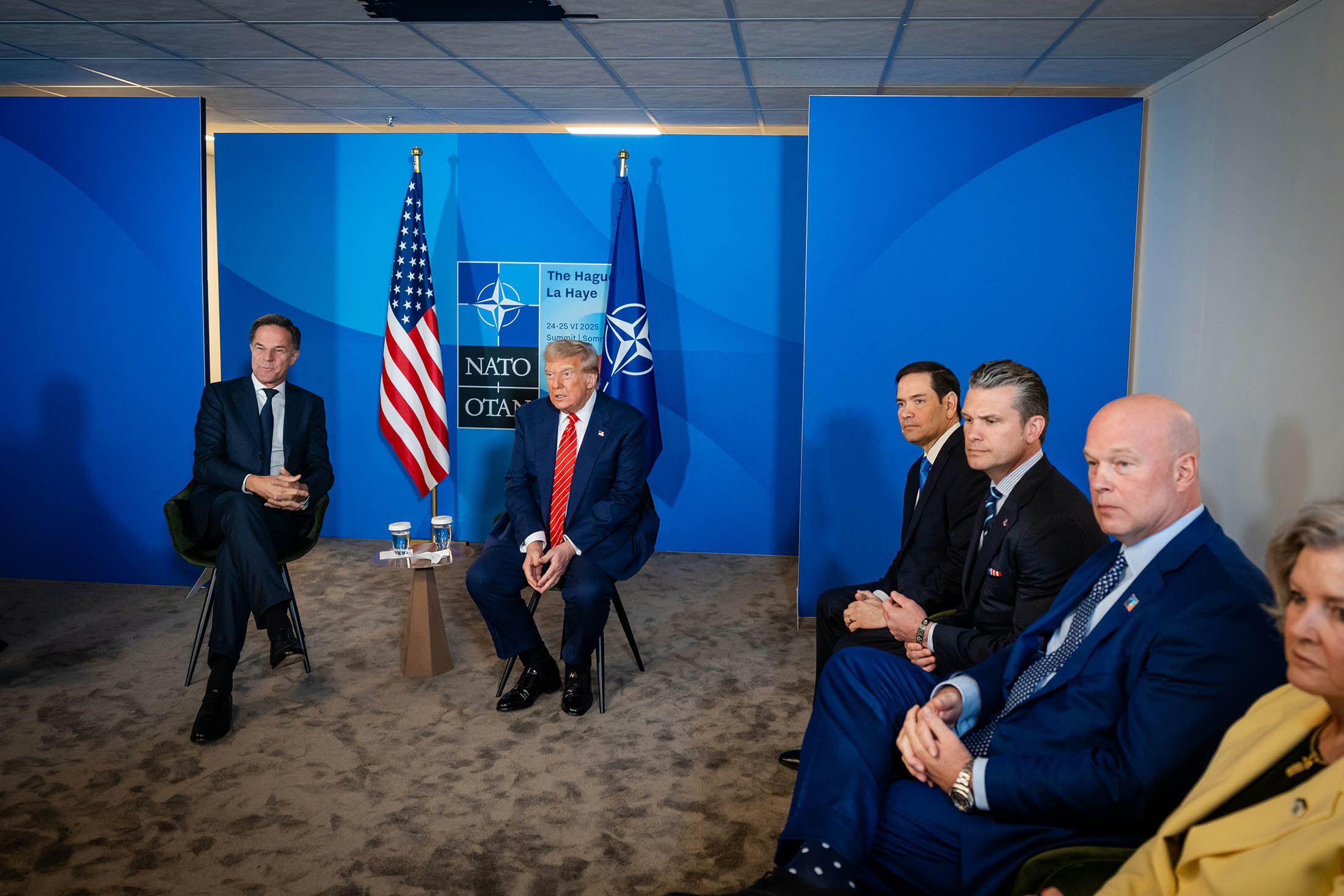
The NATO 2025 Summit served as a pivotal event– reaffirming the alliance’s commitment to bolster its collective defense and strengthen the transatlantic partnerships.
Of a crucial note,
Initiated by President Trump, the summit yielded a groundbreaking consensus on advancing the defense expenditure, as allies ratified a new comprehensive defense investment plan, elevating it to 5% of GDP by 2035.
The augmented investment will be instrumental in materializing NATO’s central objectives including:
In today’s volatile and evolving geopolitical landscape, a strong, united and adaptable NATO that stands as a leading and a resilient force, is not merely necessary for the transatlantic security and defense but equally essential for global peace and stability.
June 2024

An exclusive interview with Hon. General James B. Hecker Commander Allied Air Command, conducted by Editor in Chief, Catherine S. Schmidt
General James B. Hecker is Commander, Allied Air Command headquartered at Ramstein Air Base, Germany; and Director, Joint Air Power Competence Centre at Kalkar, Germany.
In his capacity as Commander, Allied Air Command, General Hecker is responsible to the Supreme Allied Commander Europe for the Air and Missile Defence of NATO Alliance member nations during peacetime operations. His command ensures the preservation of Alliance territorial integrity from Northern Norway to Southern Italy and from the Azores to Eastern Türkiye, including every European NATO nation. Furthermore, in the event of a joint NATO operation he is the responsible commander of the Air Component.
General Hecker is also Commander, U.S. Air Forces in Europe and U.S. Air Forces Africa. In this capacity, he commands U.S. airpower across more than 19 million square miles. This area also includes 104 countries in Europe, Africa, Asia and the Middle East, the Arctic, Atlantic and Indian Oceans, possesses more than a quarter of the world’s population, and generates more than a quarter of the world’s gross domestic product.
Honorable General, it’s a great privilege and real honor to have this interview with you. Thank you for your time Sir.
With your permission I start the first question about the the multinational live-fly Exercise INIOCHOS 24, which took place at Andravida Air Base in Greece from April 8 to April 18, 2024. What were the main objectives of this exercise?
Hon. Gen. James B. Hecker: Exercise INIOCHOS 24 offered a great opportunity for participants to fly complex missions, specifically designed to enhance interoperability and increase combat readiness. During the exercise, we covered the full spectrum of air operations including Air Power Contribution to Counter-Land and Maritime Operations and Combat Search and Rescue. Both offering live flying during composite air operations or COMAOs and using the Hellenic Air Force’s F-16 Tactical Simulators greatly enhanced achieving the participants’ training objectives. Participating crews (from Host Nation Greece and NATO members France, Montenegro, Romania, Spain, the United Kingdom, the United States and non-NATO members Cyprus, and Qatar) operated in a simulated complex and congested air environment with multiple modern threats and real-time live injects specially designed to enhance interoperability and increase combat readiness, building a stronger and more agile Alliance. Continue to read the interview
April 2023
Special Edition Interview with NATO Allied Maritime Command Spokesperson, 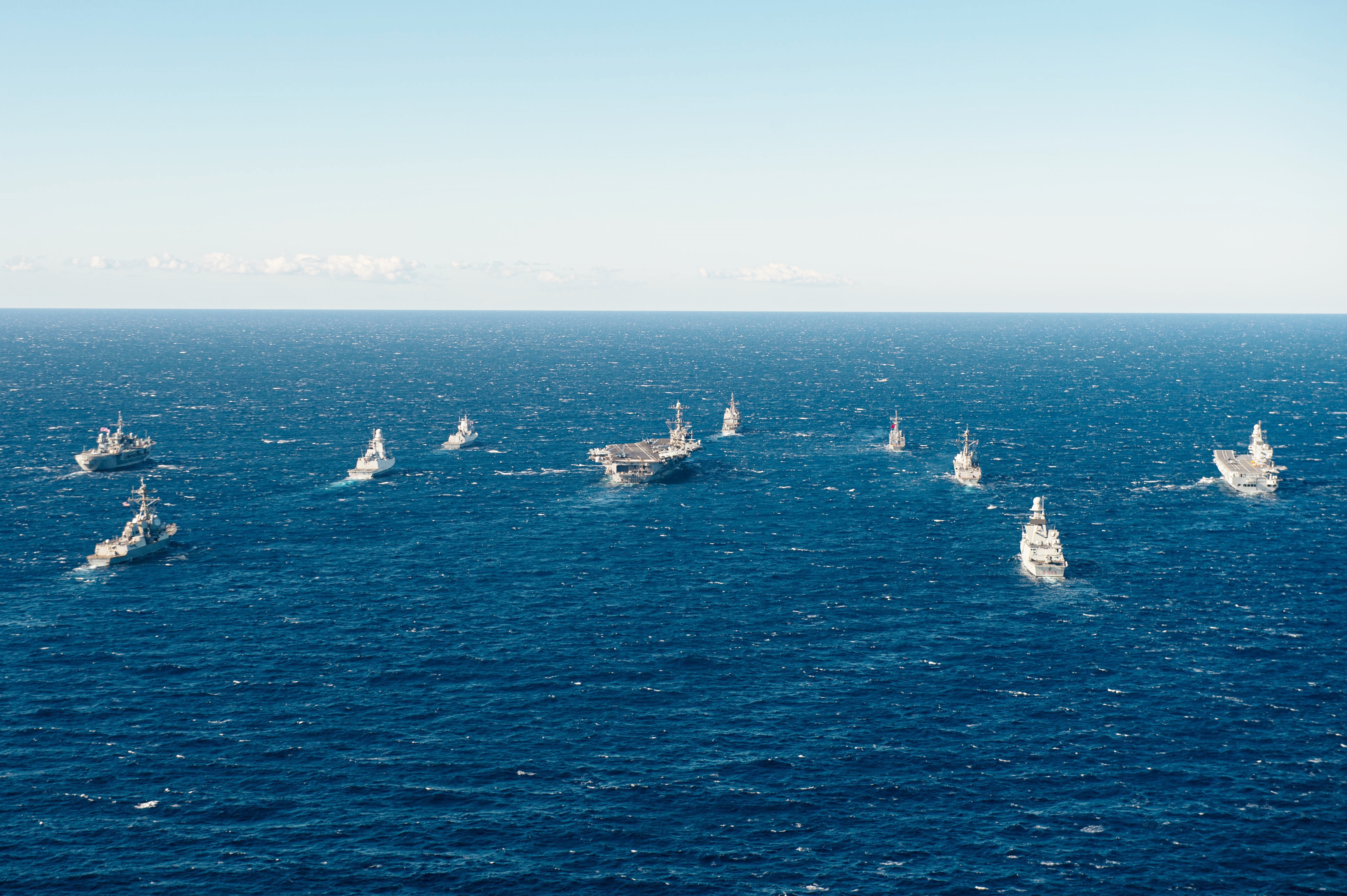 conducted by Editor in Chief, Catherine S. Schmidt
Q 1: Could you please walk us through the landscape of Allied Maritime Command (MARCOM) – the structure, the missions, and the importance of MARCOM’s Maritime Security, 360° Deterrence and Defence at Sea?
NATO Allied Maritime Command Spokesperson: NATO Allied Maritime Command (MARCOM) is the central command of all NATO’s standing maritime forces. The Commander of MARCOM is the principal maritime advisor to the Supreme Allied Commander Europe (SACEUR) and for a decade we have been the sole Maritime Component Command for the Supreme Headquarters of the Allied Powers Europe (SHAPE).
Located in Northwood, United Kingdom, MARCOM is a multinational headquarters manned by over 400 officers, petty officers and civilians from NATO countries and representatives from NATO partner nations. MARCOM’s area of responsibility ranges from the Arctic, to the North Atlantic, to the Baltic, Mediterranean and Black Seas.
There are four permanent Task Groups under its command – Standing NATO Maritime Group One and Two (SNMG1 and SNMG2) and Standing NATO Mine Countermeasures Group One and Two (SNMCMG1 and SNMCMG2). These four Maritime Groups are NATO’s integrated maritime force, made up of Allied Nations’ contributions. Under continuous full NATO operational command, these warships are assigned a variety of tasks; from compiling and maintaining a comprehensive maritime picture and situational awareness, to operational missions and and vigilance activities to ensure Alliance readiness to respond if needed.
In addition, under Operation Sea Guardian, an operation that has been stood up to enhance security in the Mediterranean, MARCOM is contributing to capacity building for partner nations and conducts six focused operations each year with a specific focus on areas of interest in the Mediterranean Sea.
January 2023
Special Edition Interview with the NATO Allied Air Command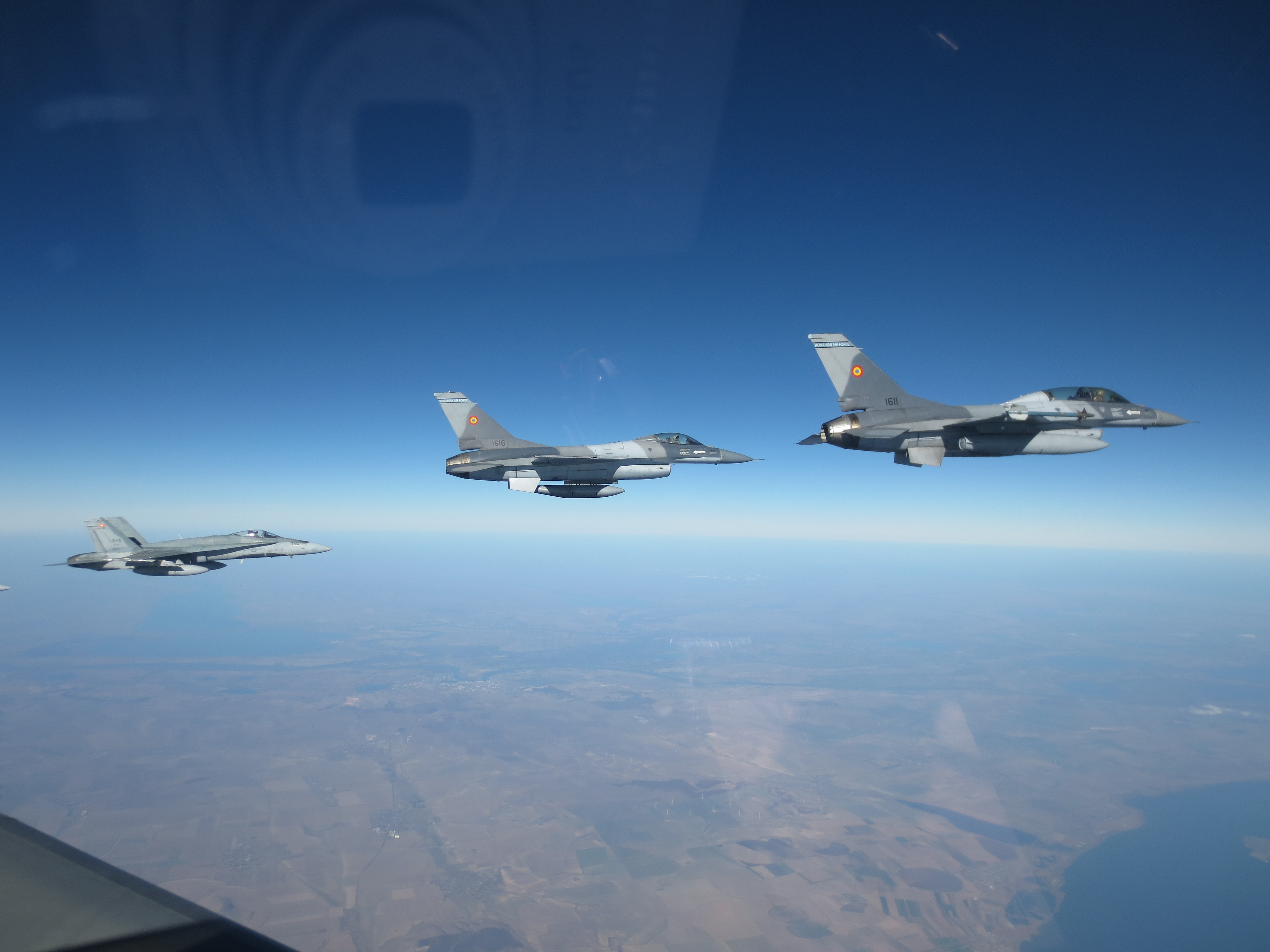 Spokesperson conducted by Editor in Chief Catherine S. Schmidt
Special Edition Interview with the NATO Allied Air Command Spokesperson, conducted by Editor in Chief Catherine S. Schmidt
Q: What is the role of Allied Air Command (AIRCOM) and its position and response to the Russian war in Ukraine?
NATO Allied Air Command Spokesperson: While not a party to the war that Russia is waging in Ukraine, NATO stands united and in full solidarity with the government and people of Ukraine in the defence of their country. NATO nations are providing unprecedented support to help Ukraine uphold its right to self-defence, which is enshrined in the UN Charter. NATO has made clear that it will continue to support Ukraine for as long as it takes. At the same time NATO remains vigilant, calm and closely coordinated, and will always do what is necessary to protect and defend all Allies.
In response, NATO has substantially increased the number of fighter jets on alert across Eastern Europe to send a clear message that we stand ready protect and defend every inch of allied territory. In the wake of Russia’s war, there has been an increased use of missiles, Unmanned Aerial Vehicles (UAVs) and combat aircraft close to the borders of NATO nations. NATO air forces have bolstered their presence in the eastern part of the Alliance. Their presence helps to shield NATO against any aggression. Several dozen fighter jets are on alert at all time to respond to possible airspace violations and to deter aggression under our 24/7 collective defence Air Policing mission.
Continue to read the interview
September 2021
Interview with the NATO Air Command Spokesman, conducted by Editor in Chief, Catherine S. Schmidt
Sir, we are delighted to have the occasion of this interview with you. Thank you very much indeed for accepting our invitation.
Q: 1 Could you please tell us about the historical formation and the current architecture of NATO Air Command.
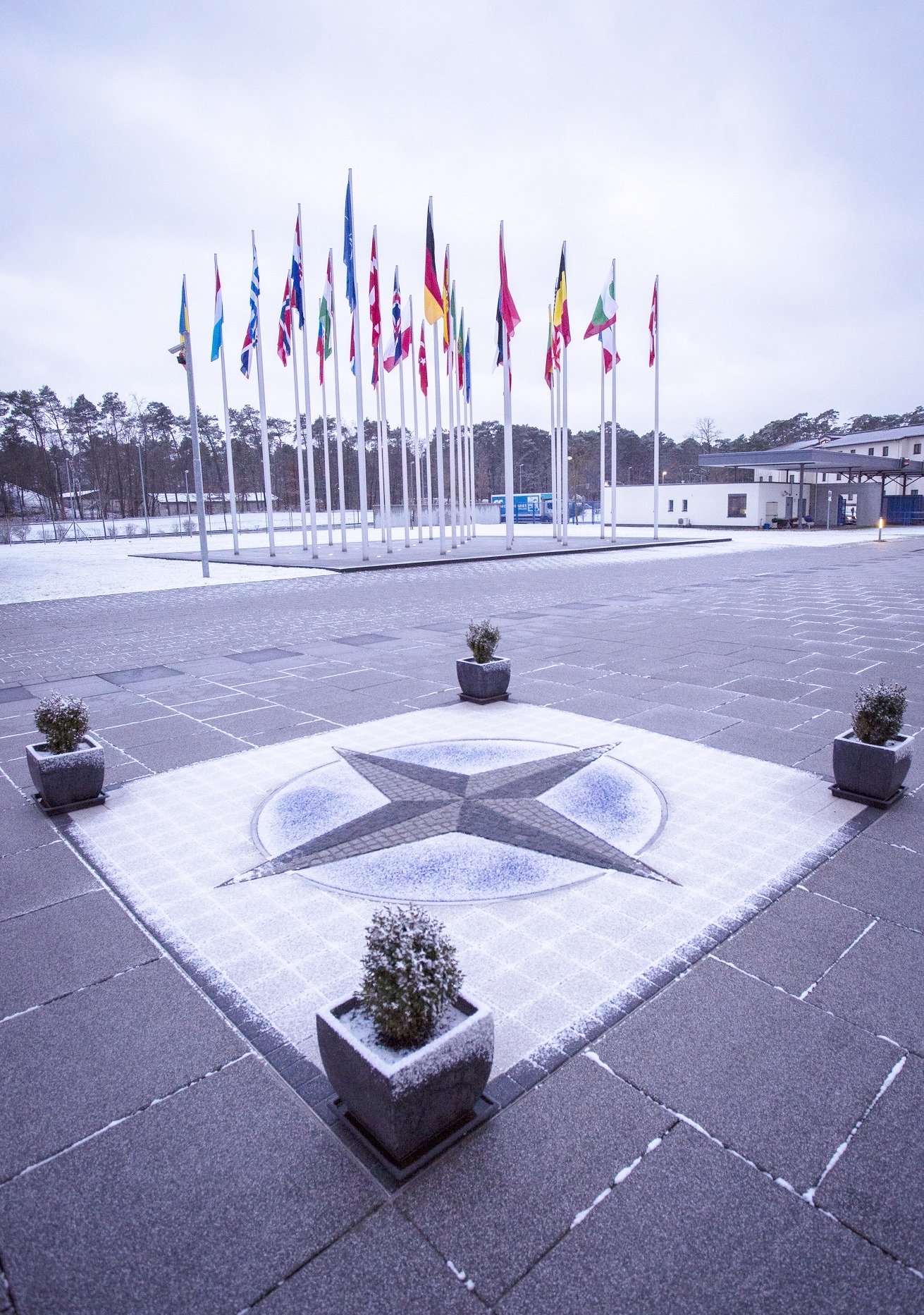 NATO Air Command spokesman: Headquarters Allied Air Command is located at Ramstein, Germany, within Ramstein Air Force Base, which has been home to a NATO Airpower headquarters since 1974. The headquarters is responsible for planning, exercising and executing Integrated Air and Missile Defence Operations within NATO’s European area of responsibility from peacetime through to conflict. The Headquarters includes the Operations Centre for Air Policing, Ballistic Missile Defence and operational control of NATO’s Airborne Early Warning and Control Force as well as for NATO’s Alliance Ground Surveillance Force. The Headquarters can also host a Joint Force Air Component to command and control allied air operations during crisis and conflict. More than five hundred dedicated military and civilian personnel, increasing to some 620 in support of the adapted structure, serve at the Headquarters, representing 25 NATO member nations. The staff is permanently augmented by representatives from three of NATO’s partner nations, Sweden, Finland and Azerbaijan. Subordinate units to the Headquarters are the two Combined Air Operations Centres at Uedem, Germany and Torrejón, Spain as well as the Deployable Air Command and Control Centre at Poggio Renatico, Italy.
Continue to view the interview
September 2021

Contributed by NATO Military Official
NATO is supporting the evacuation and relocation of Afghans. Elements of the NATO Response Force (NRF), commanded by Admiral Robert P. Burke (US Navy), are leading the operation and providing care, security, processing and accommodation for the Afghan evacuees.
The NRF has robust command and control capability, ideal for a mission of this size and complexity. It provides collective defence and a rapid military response in times of crisis, but it can also perform peace-support operations, provide protection to critical infrastructure, and support disaster relief. The NRF is regularly exercised, for instance during exercise Steadfast Defender 21 earlier this year, exercise Noble Jump 19 and exercise Trident Juncture 18.
The core element of the NRF in this operation is the Joint Logistics Support Group Naples (JLSG) that forms Task Force Noble.
More than 20 Allied nations are contributing, providing transportation aircraft, construction equipment, ambulances, medical teams, civil affairs teams and security personnel.
Around 300 NRF troops are deployed in temporary locations hosting Afghan evacuees. We are working closely with Poland and institutions in Kosovo, who have agreed to temporarily host the evacuees. There are also hundreds of NATO personnel supporting the operation from our commands and headquarters. For instance, NATO’s Allied Air Command, based in Ramstein, Germany, has been critical to this effort, providing transportation aircraft and crews.
We are committed to ensure a safe and compassionate transfer of the Afghan evacuees, through a series of temporary locations and on to resettlement. It is a huge effort, and Allies and partners are coming together to make it happen as quickly as possible. At this point, it is too soon to know how long the operation will take.
Acknowledgment: Article by NATO military official September 2021 (Copyrighted material)
Additional: NATO Staffs work together to help Afghan refugees in Spain
July 2021
Atlantic Resolve is the continuation of U.S-led measure which began in 2014 under the Department of Defense ‘European Deterrence Initiative’ to enhance NATO military capacities.
“The United States is demonstrating to NATO allies and the world its continued commitment to peace, security and stability in Europe.” highlighted the Department of Defense on the importance of the Atlantic Resolve
This year as well the operation continues to execute series of bilateral and multilateral training in different parts of Europe with the participation of the armed-forces from most European States including: Belgium, Bulgaria, Czech Republic, Denmark, Estonia, France, Georgia, Germany, Greece, Hungary, Italy, Latvia, Lithuania, Netherlands, Norway, Poland, Romania, Slovakia and the United Kingdom. Indicated by U.S Army Europe and Africa, 7000 soldiers from U.S are assigned on rotational deployment to Europe as a part of Atlantic Resolve.

“U.S. Army Europe’s Operation Atlantic Resolve demonstrates continued U.S. commitment to collective security. This reassures NATO allies and partners of America’s dedication to enduring peace and stability in the region following Russia’s intervention in Ukraine.” described the U.S Army in 2017
“Deterrence requires ready and capable allies in Europe, which is why we have enhanced the frequency and complexity of exercises with NATO allies and partners, while augmenting the U.S. air, ground, and naval presence in the region.
The U.S.-European strategic partnership is built on a foundation of shared values and common experience, and we build on that foundation with a robust training and exercise plan.” announced the White House in 2016
Acknowledgments: the Infographic of Atlantic Resolve 2021©U.S. Army Europe and Africa. Sources: DoD, U.S Army, U.S Army Europe and Africa. Article by Editor in Chief, Catherine S. Schmidt.
July 2021
Interview with the Belgian Chief of Defence Hon. Admiral Michel Hofman, conducted by Editor in Chief, Catherine S. Schmidt
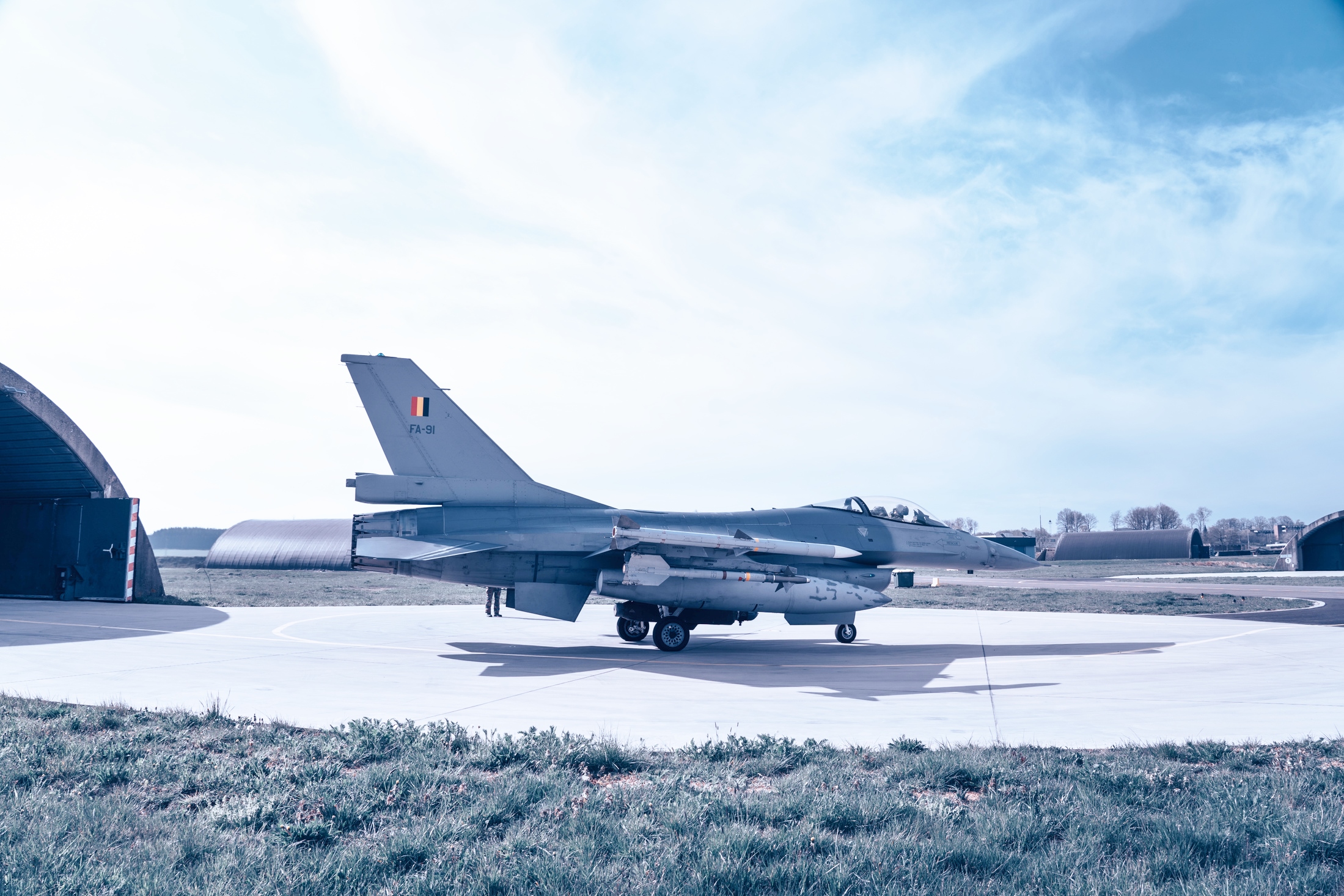
Q: 4 In late March this year NATO announced that Belgian F-16s are ready for NATO Response Force. Could you discuss about this mission and the role that Belgium is holding in it.
Indeed, at the end March 2021, NATO completed a tactical evaluation of the Belgian air combat capability, flying F-16. This process started in 2019 but due to COVID-19, we experienced some inevitable delays.
NATO’s Readiness Forces are one of the cornerstones in the Alliance’s Deterrence and Security Policy and thus an important pillar of collective defence, one of NATO’s core tasks. By meeting NATO’s evaluation standards, we demonstrated our Air Force’s ability to operate at par with our Allies, supporting the Alliance, contributing to its readiness forces and other engagements such as Baltic Air Policing.
Apart from our Air Force, Belgium also provides maritime capabilities for NATO’s Standing Naval Forces and Land Forces for NRF and engagements such as enhanced Forward Presence. Such contributions are a clear sign of our willingness to take on our responsibility and share the burden regarding collective defence. It is a testimony of our commitment to the Alliance, our solidarity with our Allies and our reliability.
In order to remain relevant, keeping up with technological evolutions, Belgium invested in the replacement of its major combat platforms such as our air combat capability. As from 2023, the F-16 fleet will transition to F-35 over a period of five years. The same process is planned for regarding the replacement of our land combat vehicles, air transport capability, frigates and mine hunting vessels, albeit each within its own time frame. Although these transitions are very challenging, we will of course respect our operational commitments to NATO and our level of readiness.
Q: 5 Belgium and the United States enjoy very special relations in the diplomatic field, in trade cooperation, as well as in defence and security partnership. As decades of military joint training and exercises, joint forces in the overseas operations are all real presentations that accentuate this fact. Would you please comment on U.S-Belgian Armed Forces partnership.
Belgium was liberated by American and Canadian soldiers at the end of the Second World War and with the Battle of the Bulge a special bond was created between our two countries. The post-war period was characterized by a strong Trans-Atlantic cooperation with the creation of NATO in 1949. Since then Belgo-American relations have grown strong in a sphere of mutual respect.
Obviously, the United States remain the important Strategic partner for Belgium and Europe in general with common values and strategic interests as the basis of this partnership. The enhanced cooperation on security and defence is the evident consequence of common values as the strengthening of the multilateral system and democracy around the world.
Continue to read the interview
July 2021
Interview with the Belgian Chief of Defence Hon. Admiral Michel Hofman, conducted by Editor in Chief, Catherine S. Schmidt
Hon. Admiral we are profoundly honored to have this special occasion with you. Thank you very much for accepting our invitation.
Q: 1 I would like to start the first question with the comprehensive view of the Belgian Armed Forces. Could you please tell us about Belgium’s strategic interests and engagements in the overseas missions.
The effective engagements of the Belgian Defence are situated in the framework of deterrence and collective defence, collective security, the protection of the Belgian citizens and interests abroad, and the assistance on the national territory in case of crises or emergencies. The objective is to remain a reliable and important partner within the UN, the EU and NATO. As a small country in the centre of Europe and in the strong conviction of the complementarity between the European approach and NATO’s role, Belgium continues to promote multilateralism and the integrated approach of the European Union.
When it comes to deterrence and collective defence, it goes without saying that we ensure a fair contribution to the NATO Readiness Action Plan with engagements on the eastern flank of the alliance. Belgian Defence is among others present with ground forces embedded in a German Battle Group in Lithuania, we have a long tradition of contributing to the Air policing Mission in the Baltic States and to the NATO’s Defence Capacity Building (DCB) projects in countries on the eastern flank. Furthermore, Belgium continuous to contribute to the NATO Response Forces, the Readiness Initiative and the Standing NATO Maritime and Mine Counter Measure Groups. By taking up its responsibility, Belgium wants to remain a reliable partner within NATO.
Continue to read the interview
June 2021

Interview with H.E. Ambassador Liselotte Plesner, Permanent Representative of Denmark to NATO, conducted by Editor in Chief, Catherine S. Schmidt
Your Excellency Ambassador Plesner, we are very much honored to have this interview with you. Thank you for giving us this occasion.
Q 1: The first question is about Denmark’s leadership in NATO, and the military concept of ‘Denmark’s Security is deeply rooted in NATO’ proclaimed by Danish Ministry of Defence. Please give us a panoramic view of Denmark’s leadership in NATO and what this concept means for the role and commitments that Denmark holds in the Transatlantic security and defence.
Thank you, it is always a pleasure to talk about the importance of NATO and this is a great opportunity to create awareness about Denmark’s work and active role within NATO.
Denmark’s security is indeed deeply rooted in NATO, and for the past 72 years NATO has been the cornerstone of Danish defence and security policy. We have continuously contributed to the adaption of NATO to fit the world’s ever changing challenges, all resulting in maintaining NATO as the world’s most successful alliance. NATO is a central platform for foreign-, security- and defence consultations among allies on both sides of the Atlantic, and under American leadership the Alliance has ensured peace in the Euro-Atlantic area allowing the people of Denmark to prosper in a free and open society.
We are a small country, and we cannot face our security challenges alone. NATO is the guarantor of our security and by virtue of its role as a value-based organisation the guarantor of our way of life.
In 1949, NATO was founded on the same principles and values as we stand for today, and it is essential for Denmark together with allies and other like-minded countries to uphold and protect our values such as democracy, individual freedom, and the rule of law as laid out in NATO’s founding Washington treaty.
Safeguarding the rules-based international order is also important for the Alliance. This is why NATOis currently working on the forward-looking agenda NATO2030. We see a fundamental shift in the global balance of power, and NATO needs to be fit to match the derived consequences as well as the challenges that persist. Euro-Atlantic security depends on strong transatlantic bonds and we are therefore looking forward to this year’s summit and to recommitting to our special bond and shared values.
NATO 2030 and the upcoming summit comes at a pivotal moment for the Alliance. The current security environment is both complex, unpredictable, and the most challenging since the fall of the Berlin Wall. Systemic competition with countries that do not share our democratic values and undermine the rules-based international order as well as terrorism, disinformation campaigns, cyber attacks and climate change all require constant adaptation and agility. Consequently, Denmark has actively sought to respond through the Alliance by continuously increasing our shared focus on the capabilities required by NATO to maintain our collective deterrence and defence.
Denmark has contributed substantially to NATO operations and missions throughout the years, including through the command of NATO Mission Iraq, the present contribution to NATO’s missions in Afghanistan and Kosovo, and regular contributions to NATO’s enhanced Forward Presence (eFP) in the Baltic Sea Region and NATO Air Policing. Denmark has been ready to contribute, also, to difficult operations and missions to the benefit of Allied security. I believe that our contributions and continuous engagement has given us the reputation as a constructive and capable ally.
March 2021
Interview with NATO Deputy Spokesperson, the Hon. Mr. Piers Cazalet, conducted by Editor in Chief, Catherine S. Schmidt
Sir, it is a great Honor to have you in this interview. Thank you very much indeed for accepting it.
Q 1: With respect to NATO 2030, can you discuss the key elements identified and expounded in the meetings of the Defense Ministers at NATO Headquarters, 17-18 February 2021?
NATO Deputy Spokesperson, Mr. Piers Cazalet: Thank you for this opportunity to speak to U.S Europe World Affairs. The meeting of NATO Defence Ministers in February was the first with Secretary of Defense Lloyd Austin. It represented an important milestone in our preparations for our summit later this year.
As for the NATO 2030 initiative launched by Secretary General Stoltenberg, it is informed by two fundamental premises. First: in the current historical juncture we have a unique opportunity to open a new chapter in relations between Europe and North America. Second: the number and scope of global challenges are such that no country and no continent can tackle them alone. Ultimately, the goal of the NATO 2030 initiative is to make NATO fit for the future.
Under the NATO 2030 initiative, Secretary General Stoltenberg has put forward a number of ambitious proposals. They cover key areas.
Continue to read the interview
April 2017
NATO Secretary General Jens Stoltenberg traveled to U.S, and met with President Donald Trump on April 12. During this meeting President Trump reassured NATO of the United States’ unwavering commitment and the continuation of supports
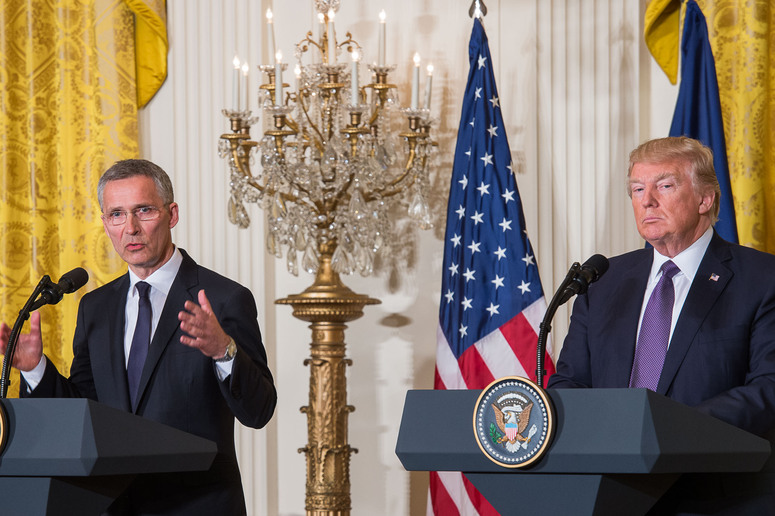 Press conference by President Donald Trump and NATO Secretary General Jens Stoltenberg. April 12 2017 © NATO Press Office
The two leaders also discussed a wide scope of subjects covering: Syria, Iraq, defeating ISIS, other International security issues, and the up coming NATO summit in its headquarters Brussels in May.
Excerpts from President Trump’s remarks in the joint press conference:
“Sixty-eight years ago this month, not far from where we are gathered today, President Harry Truman spoke at the signing of the North Atlantic Treaty. In the nearly seven decades since Harry Truman spoke those words, the NATO alliance has been the bulwark of international peace and security.”
“NATO allies defeated communism and liberated the captive nations of the Cold War. They secured the longest period of unbroken peace that Europe has ever known. This enduring partnership is rooted out of so many different things, but our common security is always number one, and our common devotion to Human dignity and Freedom.”
Secretary general, I’m honored to have you here today and to reaffirm our commitment to this alliance and to the enduring values that we proudly — and I mean very proudly — share.” April 12, 2017 ©NATO Press Office
Excerpts from NATO Secretary General Stoltenberg’s remarks in the joint press conference:
“Thank you so much, Mr. President. We just had an excellent and very productive meeting. And it’s really an honor to meet you for the first time, here in the White House.
We agree that NATO is a bedrock of security both for Europe and for the United States. Two World Wars and a Cold War have taught us all that peace in Europe is not only important for Europeans, but is also important for the prosperity and the security of North America.
So a strong NATO is good for Europe, but a strong NATO is also good for the United States. And therefore I welcome the very strong commitment of the United States to the security of Europe. We see this commitment not only in words but also in deeds.
So Mr. President, thank you once again. I look forward to working with you to keeping the Alliance strong.” April 12, 2017 © NATO Press Office
Addition: NATO Secretary General Stoltenbergin a town hall meeting at George Washington University’s Elliott School.
March 2017
Defense Secretary Mattis met with NATO Secretary General Stoltenberg at the Pentagon on March 21. The Two leaders discussed range of Defense and Security issues including, countering the emerging challenges, fighting with ISIS and strengthening the Transatlantic Relations.
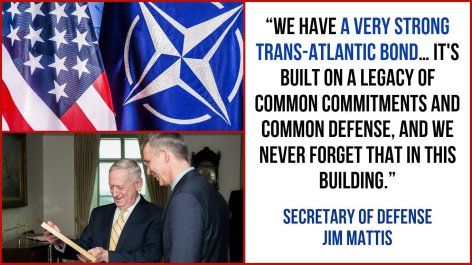
Washington DC, March 21, 2017 © US Mission to NATO
“But I just also want to say thanks to you personally for your leadership, for the moral example that you set. NATO, under you, is evolving to defend against aggression and respond to terrorist threats along the southern flank in the Mediterranean and the Turkish border.
I look forward to engaging with the coalition members who are here this week on the counter-ISIS fight. And I’m confident that NATO will, as always, be one of the leaders as we deal with this threat.” Highlighted Defense Secretary Mattis during his meeting with the NATO Secretary General Stoltenberg at the Pentagon. March 21, 2017 © DoD Press Office
Emphasizing the importance of the Transatlantic Relations, NATO Secretary General Stoltenberg during his meeting with the Defense Secretary Mattis expressed :
“Thank you so much. And thank you for welcoming me and my delegation. It’s great to be here in Washington, and to meet with you. And I also commend you for your strong personal support and leadership when it comes to NATO and the trans-Atlantic bond.”
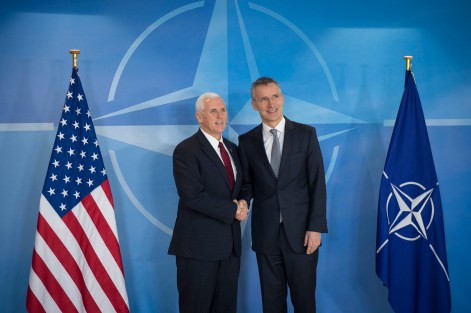 Vice President Mike Pence and NATO Secretary General Stoltenberg meeting at NATO Headquarters Brussels. February 20, 2017© NATO
Excerpts from the remarks by Vice President Mike Pence in the press conference with NATO Secretary General:
“It is my privilege here at the NATO Headquarters to express the strong support of President Trump and the United States of America for NATO and our transatlantic alliance. ”
“The United States has been a proud and faithful member of NATO since its founding in 1949. This alliance plays a crucial role in promoting peace and prosperity in the North Atlantic and, frankly, in the entire world.”
“The United States’ commitment to NATO is clear. ” February 20, 2017 © The White House
Excerpts from the remarks by NATO Secretary General Jens Stoltenberg during press conference with Vice President Pence:
“The bond between the United States and NATO — between the United States and Europe embodied in the NATO alliance is very important today because we live in times of turmoil and instability, and then we need a strong alliance more than ever. And we are stronger when we stand together.”
“This will be an important point when allied leaders meet here in Brussels in May. So, Mr. Vice President, thank you for our excellent discussion. We agree that NATO is the most successful alliance in history because NATO has been able to adapt and change when the world is changing. And we agree that we must continue to change to keep our people safe. U.S. leadership remains indispensable. So I really look forward to working with you and to welcoming President Trump in Brussels in May.” February 20, 2017 © The White House
On the same day Vice President Pence met with EU Commission President Jean-Claude Juncker, the High Representative of the European Union for Foreign Affairs Federica Mogherini, and with the President of European Council Donald Tusk
Excerpts from the remarks by President of the European Council Donald Tusk following meeting with Vice President Pence:
“I asked the Vice President directly if he shared my opinions on three key matters: international order, security, and the attitude of the new American administration towards the European Union.”
“In reply to these three methods, I heard today from Vice President Pence three times, yes. After such a positive declaration, both Europeans and Americans must simply practice what they preach.”
“Referring to some statements made in Munich just two days ago, I would like to say clearly that the reports of the death of the West have been greatly exaggerated. Whoever wants to demolish that order, anticipating a post-West order must know that in its defense we remain determined.” Belgium February 20, 2017 © The White House
Excerpts of the remarks by Vice President Mike Pence following meeting with President of EU Council Donald Tusk:
“But the President did ask me to come here to Brussels, to the home of the European Union, and deliver an additional message. And so today it is my privilege on behalf of President Trump to express the strong commitment of the United States to continued cooperation and partnership with the European Union.”
“Whatever our differences, our two continents share the same heritage, the same values, and above all, the same purpose: to promote peace and prosperity through freedom, democracy, and the rule of law. And to those objectives we will remain committed.” Belgium February 20, 2017 ©The White House
Follow us on Twitter:@USEUWAffairs
By Catherine Stella Schmidt
March 2017
The Italian Air Force has re-assumed for the second time NATO Air Policing Operation, leading the mission from mid March until mid April 2017.
The Operation is formulated to ensure the security and integrity of NATO member’s Airspace, to increase the interoperability and integration of Iceland’s Air Force with the NATO’s Integrated Air and Missile Defense System.
“This joined Aerial defense in the Iceland is a clear example of rational management and sharing of the available resources among NATO member States.” Elaborated General Claudio Graziano, Chief of Italian Defense March 7, 2017 © Italian MoD
Described by the Italian Ministry of Defense: The Air Force has deployed six Eurofighter to the operation and its task will be to ensure the security surveillance of Iceland Airspace until mid-April, while conducting joint Training activities with the local Coast Guard.
December 2016
“The United States is absolutely committed to the defense of NATO, and that means having full-spectrum capabilities not only within U.S. forces, but with NATO and partner nations as well.” highlighted the U.S Department of Defense in the news-article on December 13,2016.
While Military capabilities are known by the number of the troops and Military personnel –Power and Defense assurance are projected by advanced equipment, technology, the best training that could execute the required strategies, command and tactics in the theater fields.
The U.S Amy Europe and its 7th Army Training Command in Germany, has been the main center to build the NATO members’ Armed-Forces by regular training that to maximize the interoperability; the multinational exercise, joint maneuvers, the exchange of ideas and commands — aimed all to fortify the U.S-European Armed-Forces and bolster the NATO members’ Military to the higher capabilities of Physical and Cyber Defense.
In early 2016 the United States has announced also the increase of the budget for NATO in the European Reassurance Initiative plan, as a further demonstrations of U.S commitment to safeguard European Freedom, Peace and Security.
December 2016
NATO Foreign Ministers meetings, December 6-7 in Brussels, were concluded with the strategic focus on strengthening Transatlantic cooperation and projecting Stability Beyond Borders.
Described by EU High Representative for Foreign Affairs, Federica Mogherini, EU and NATO start new era of cooperation in 7 areas with the agreement on 42 proposals.
The areas of focus for more closer cooperation will be on the crucial strategic Defense and Security fields including: Operational Cooperation, Cyber Defense, Maritime Security, Defense Capabilities, Defense Industry/Research, Military Training and Exercise.
On his statement Secretary General Jens Stoltenberg highlighted: “One way of strengthening the bond between North America and Europe is by strengthening the cooperation between NATO and EU. And we have a momentum now when it comes to NATO-EU cooperation. In July, I signed a Joint Declaration with Presidents Tusk and Juncker and at the meeting today we will decide how we turn that declaration into concrete action.” Dec 6, 2016 ©NATO
Follow us @USEUWAffairs
Sources: U.S Mission NATO/NATO Public Affairs
By Catherine Stella Schmidt
November 2016
NATO Secretary General Jens Stoltenberg visited UK on November 23 and met with Prime Minister May and Defence Secretary Michael Fallon. Among other important subjects, the leaders of UK and NATO discussed on the importance of all NATO members to increase their Defence spending, NATO’s cyber capabilities, and how to adapt to the new security environment and counter the emerging threats. The Secretary General praised UK for its enduring commitments both financially and by contributing troops by stating: “UK is a strong ally at the heart of NATO”
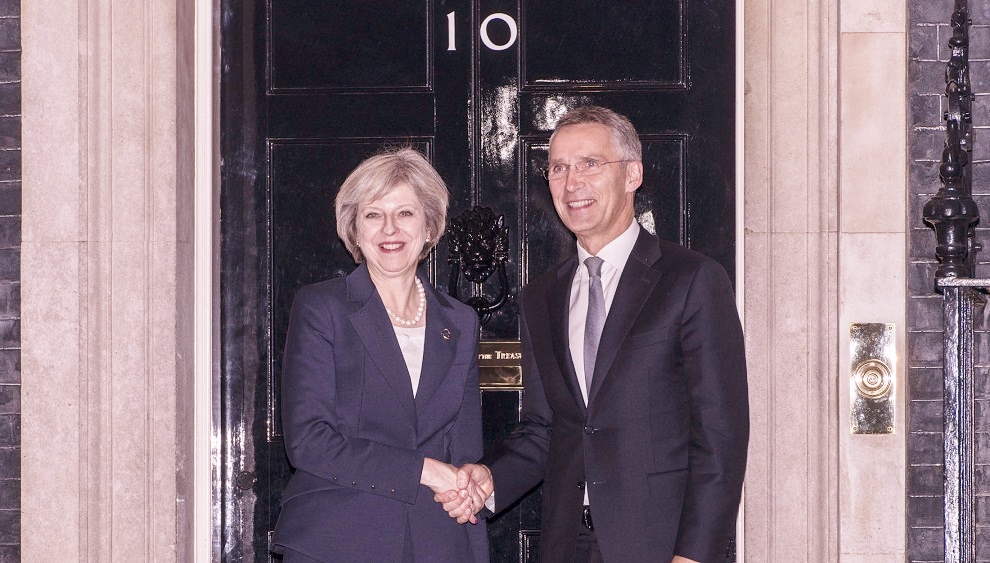
Prime Minister May and Secretary General Stoltenberg during their meeting. London November 23, 2016 © NATO Public Affairs
The spokesperson of PM Office highlighted:
“The Prime Minister reaffirmed the UK’s unwavering support for NATO and said we will remain a cornerstone of the Alliance.”
“The two leaders also discussed the recent US election and the importance of the transatlantic bond to security. Secretary General Stoltenberg relayed his recent conversation with President-elect Donald Trump, in which they had agreed on the enduring importance of NATO. ” Nov 23, 2016 © PM May’s Office
News from PM Theresa May News from Secretary General Stoltenberg
News from UK Foreign Office News from UK Armed Forces
News from PM Tony Blair International organisation
Sources: PM May’s office/NATO Public Affairs
November 2016
With the Military and official representatives from both sides, the NATO Force Integration Unit (NFIU) in Székesfehérvár- Hungary has been inaugurated on November 18th. NATO Force Integration Unit (NFIU) is part of Allied collective defence to facilitate the rapid deployment of NATO Forces, currently with 6 headquarters based in: Bulgaria, Estonia, Latvia, Lithuania, Poland and Romania. Hungary and Slovakia jointed NFIU in 2016.
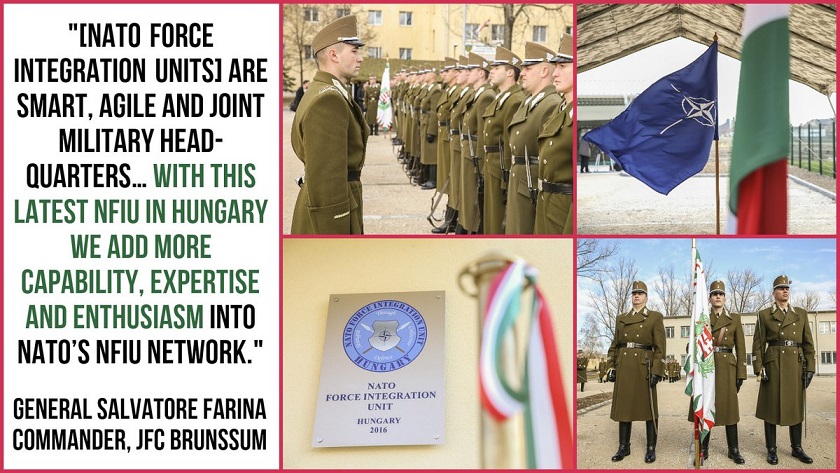
November 21, 2016 © US Mission to NATO
Attending the inauguration ceremony the Representative of NATO Secretary General Mr. Herold expressed his gratitude to Hungary for the vital role and contributions that has been providing to Alliance Security.
News from PM Viktor Orbán News from Hungarians Mission to NATO News from MFA of Hungary
Follow us on Twitter: @USEUWAffairs News from NATO Sources: NATO Public Affairs Office
November 2016
President Sauli Niinistö visit to NATO headquarters on November 9th– was a new step forward to strengthen NATO-Finland relations.
Described by Secretary General Stoltenberg the new measures will be the expansion in the fields of:
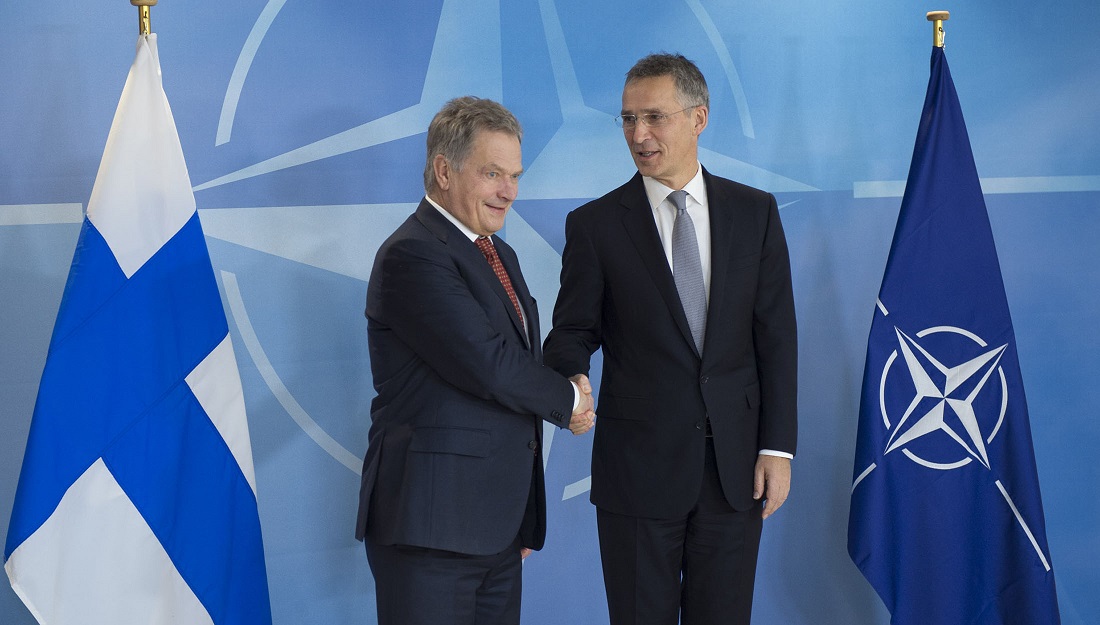
President Sauli Niinistö of the Republic of Finland during his meeting with NATO Secretary General Jens Stoltenberg. NATO headquarters, Brussels, November 9, 2016 © NATO
On the importance of Finland in NATO Secretary General Stoltenberg stated:
“This is of great importance both for Finland and for NATO because we share the same values and we face the same security challenges. NATO and Finnish troops have worked side by side as I said in many different operations and missions. And we have been able to develop a very close partnership on a range of different issues including planning for civil emergencies, and security in the Baltic Sea region. We are now expanding our cooperation when it comes to information exchanges on hybrid warfare, coordinating exercises, and developing joint situational awareness. All of this will allow Finland and NATO to address common threats more effectively.” November 9, 2016 © NATO
News from Secretary General Stoltenberg News form Finland Mission to NATO
November 2016
In his official visit to Berlin yesterday, President Obama reassured Germany and Europe that the change of administration will not change the United States’ enduring relation with Europe and will have no affect on the U.S commitment to NATO.
The World in the uncharted realm…. conflicts …..and mayhem, yet it will be necessary to maintain a strong Transatlantic Relations at Defense and Security, Political, Economic -Trade and all other aspects.

Nov 16, 2016 © US Mission to NATO
Despite false doom and gloom propaganda in some European and most German media– our research in U.S and in Europe proves that the Republican Administration have always had an extreme close relations with Europe. So will the next U.S President Mr. Donald Trump. The President-elect Mr. Trump has already assured Secretary General Jens Stoltenberg by telephone conversation that his administration will continue the support for Europe and NATO.
References: Good talk with US President-elect by NATO Secretary General Stoltenberg By Catherine Stella Schmidt
November 2016

President Obama’s visit to Europe, in his final official trip as the President and Commander-in-Chief, is an audible symbolic indication of assurance…… a major defining step that places, one more time the deeply interconnectedness of the United States and Europe, in the spotlight.
October 2016
Exercise Silver Arrow is a two-week Latvian-led exercise starting from October 17. The participant Armed-Forces are from: Albania, Canada, Estonia, Germany, Latvia, Lithuania, the Netherlands, Romania, UK and the United States.
“The Exercise is to develop relationships and leverage Allied and partner nation capabilities preserving peace through strength. And it is part of Operation Atlantic Resolve, a U.S. lead effort being conducted in Eastern Europe to demonstrate U.S. commitment to the collective security of NATO and dedication to enduring peace and stability in the region.” Highlighted by the DVIDS October 17, 2016

October 18, 2016 © US Mission to NATO
Sources: DoD/ U.S Mission NATO/U.S Army Europe
October 2016
Joint Declaration by the President of the European Council, the President of the European Commission, and the Secretary General of the North Atlantic Treaty Organization.
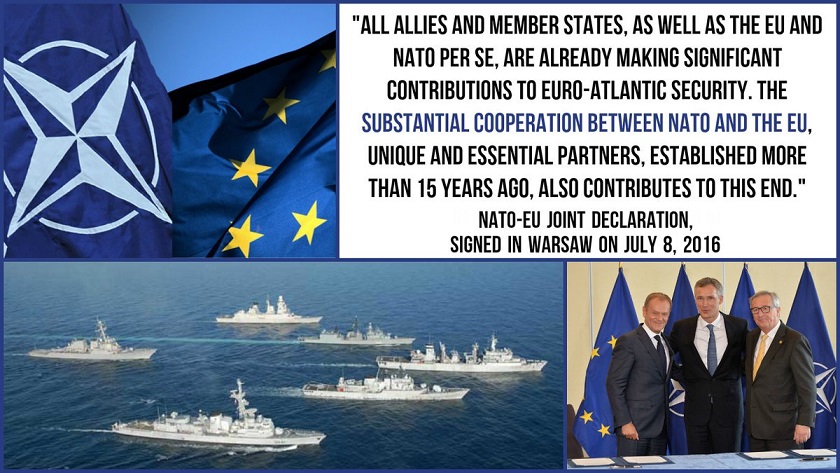
October 10, 2016 © US Mission to NATO
News from U.S. Army Garrison Bavaria
News from US Naval Forces Europe-Africa
News from U.S Air Force Europe-Africa News from Strong Europe U.S Army Europe News from U.S Mission to NATO News from NATO
September 2016
The Royal Danish Naval vessel Absalon has been deployed to Standing NATO Maritime Group 2 on September 12 to fortify the alliance in Maritime Security and counter-terrorism. The mighty ship…….seemingly serene……. is equipped with Lynx helicopter and Special Forces with the high reputation for accuracy and agile act when it enters into Operations.
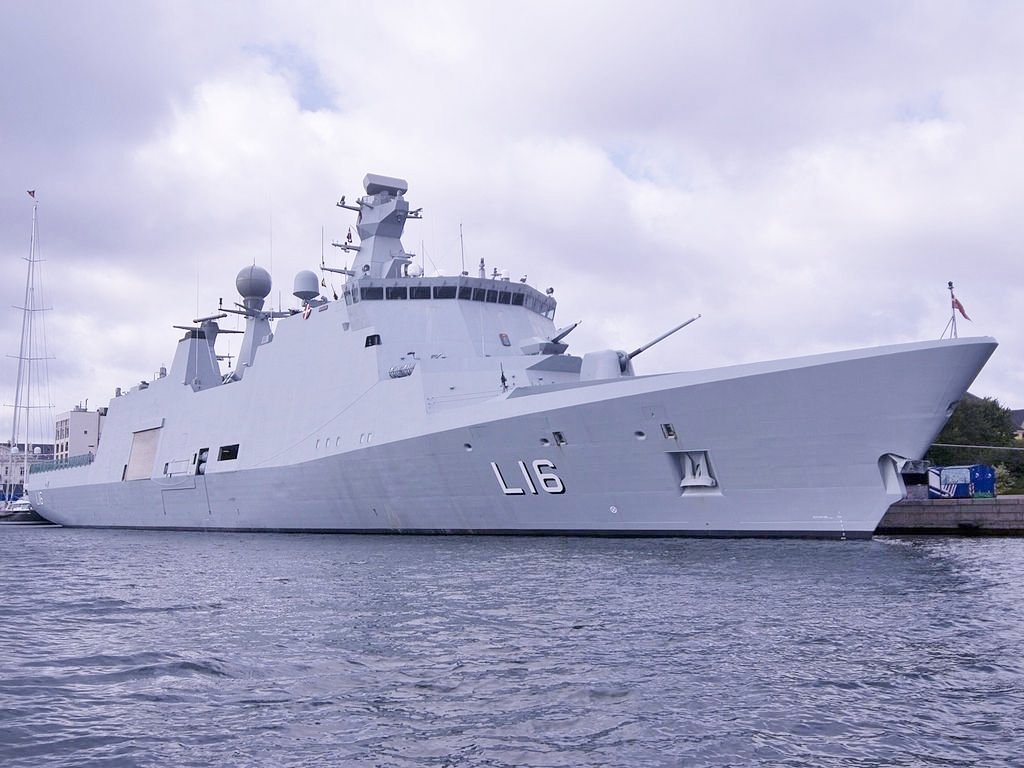
September 20, 2016 © DK mission to NATO
In its recent deployment to Mediterranean Sea as a part of Standing NATO Maritime Group-2, its tasks among others will include:
September 2016
Since August 2010 the Royal Danish Navy has been vital part of NATO Operation Oceans Shield. Its participation has been by troops, military aircraft and vessels including:
Earlier this month on September 12, Danish Vessel HDMS Absalon has rejoined the Standing NATO Maritime Group 2 in the Mediterranean Sea. This is not the first time that the support Ship Absalon has been deployed for the NATO Operation–the Vessel has been also before part of NATO Oceans Shield in 2010.

The Danish ship HDMS ABSALON in NATO Counter-Piracy Operation Ocean Shield, October 2015 © NATO’s Counter-Piracy Operation Ocean Shield
News from Ministry for Foreign Affairs of Denmark
News from Danish Mission to NATO
August 2016
On July 14, Foreign Minister Kristian Jensen visited Danish Troops stationed in Afghanistan in the NATO Mission. Minister Jensen highlighted the occasion of his visit had been, first of all to say thank you to all Danish Troops serving in the NATO Resolute Support. And also to assess the situation in Afghanistan directly.
 Foreign Minister Kristian Jensen with the Danish Troops in NATO Resolute Support in Afghanistan. July 14, 2016 © MFA of Denmark
Denmark is one of the main Troops and Financial contributors to Afghanistan from ISAF Mission to NATO’s Resolute Support. In Mai 2016 Danish Parliament ratified the Government’s plan on strengthening Danish Contingent in NATO’s Resolute Support Mission in Afghanistan and the increase of the Financial aids continuing throughout 2020.
November 2015
The United Kingdom presented NATO Secretary General Anders Fogh Rasmussen an Honorary Knight Commander of the Order of St. Michael ad St. George (KCMG)
The award was a recognition for the outstanding achievements of NATO Secretary General Anders Fogh Rasmussen during his term at the office between 2009-2014.
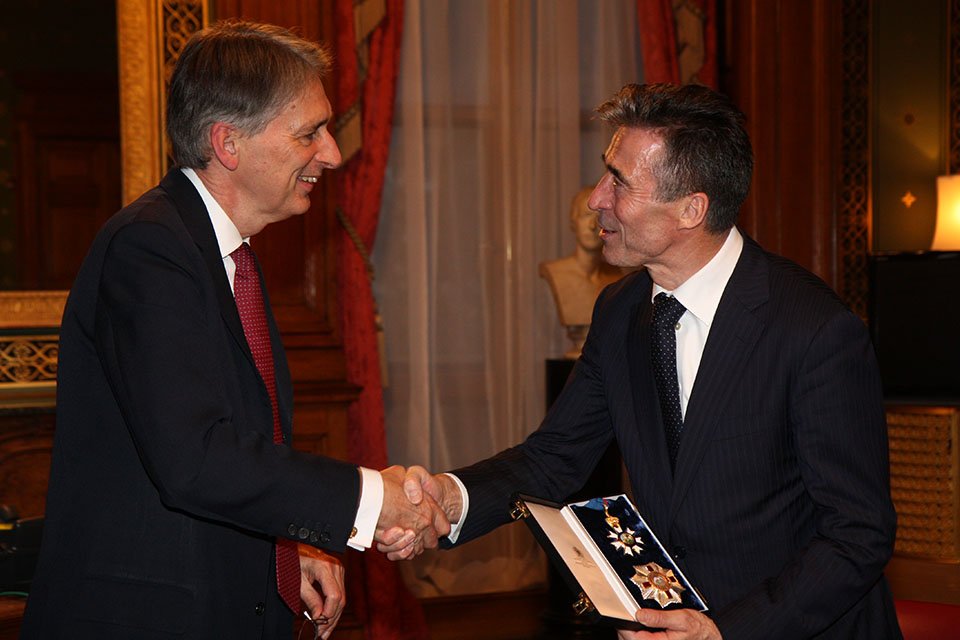 Secretary of State for Foreign and Commonwealth Affairs Rt Hon Philip Hammond with NATO Secretary General Anders Fogh Rasmussen in the official award ceremony. 17 Nov. 2015 ©UK Foreign Office
The Foreign Secretary Rt Hon Philip Hammond presented the Honorary KCMG award from the UK Foreign office to former NATO Secretary General Anders Fogh Rasmussen and elaborated:
“The 2014 Wales Summit took place at a time of significant geopolitical challenge. Under Mr Rasmussen’s leadership the Alliance set out an ambitious response, whilst maintaining unity throughout. The achievements of the Wales Summit included a new rapid reaction capability to respond to any threat, as well as an unprecedented agreement by Heads of Government to halt the decline in defence investment. His efforts included the modernisation of NATO to ensure an Alliance fit for purpose to counter 21st century threats, including in Cyber and Hybrid Warfare. Ahead of the Warsaw Summit in July next year, the UK will continue to play a leading role to ensure implementation of Wales Summit commitments, including strengthening collective Defence. With a budget of £34 billion, the UK is the largest European contributor to NATO. Earlier this year, this government announced its commitment to meet the NATO guideline of spending 2% of GDP on Defence for the rest of the decade.” ©UK Foreign Office
The NATO Secretary General Anders Fogh Rasmussen, on the occasion of the award ceremony, expressed:
“I am deeply honoured to be appointed as an Honorary Knight Commander of the Order of St. Michael ad St. George (KCMG). This award will further strengthen my ties to the British people. Let me take this opportunity to thank the UK for its invaluable contribution to the promotion of Freedom and Peace in the World. The United Kingdom is a staunch NATO ally and a bedrock of the Transatlantic Security Cooperation between Europe and the United States. I would like to extend a special thanks to the British service men and women in gratitude for their tireless efforts to make the world a safer and better place to live.” ©UK Foreign Office
October 2015
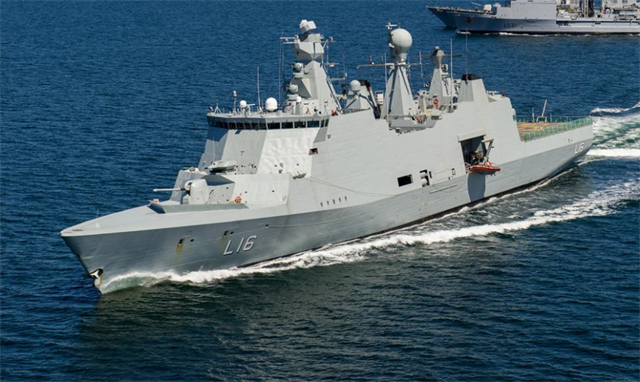 HDMS ABSALON of Denmark 2015 ©NATO
On October 1st, the HDMS ABSALON of Royal Danish Navy joined NATO Counter-piracy Operation Ocean Shield. The Operation is to keep the region safe from the threats of piracy and to maintain the Maritime Security at all level.
The Royal Navy Ship will visit the port of the Mediterranean Dialogue Partner Nations and meet with the high level Military Leaders including the Royal Jordanian Naval Force.
We are still working on this page, please visit it later again. Thank you
Legal Conditions
All the materials on US-EU World Affairs (articles, news, photos, videos, media) are from various Governmental Agencies and are strictly Copy-righted. Redistribution, reproduction, copying, or linking the content of this organization, in any kind, are prohibited by Law.
All rights reserved.
 US-Europe World Affairs