An exclusive interview with Commander of NATO-Kosovo Forces Regional Command-East Col. Jonathan D. Lloyd

An exclusive interview with Commander of NATO-Kosovo Forces Regional Command-East, Col. Jonathan D. Lloyd (U.S. Army)  

Q 1: Sir thank you for accepting this interview. Could you please elaborate on the current deployment of the U.S Army and National Guard (NG) in NATO-KFOR Regional Command East (RC-East) and their primary roles and responsibilities in the mission? And how the Army and National Guard’s contributions bolster this multinational peacekeeping mission?

Col. Lloyd: As Commander of Regional Command–East (RC-East), I lead a multinational task force under NATO’s Kosovo Force (KFOR), with U.S. Army and U.S. Army National Guard forces forming the backbone of our headquarters staff and key operational elements. The United States sustains a visible presence through a rotational, National Guard-led command, supported by Active [Duty] Component Soldiers and multinational partners. Our primary mission is to ensure a safe and secure environment for all people living in Kosovo.

U.S. forces work in partnership with multinationals to accomplish mission success through routine patrols, presence operations, quick-reaction force missions that deter malign actors, civil unrest, reassure the population, and respond rapidly to emerging security developments. Engagement is equally vital. U.S. Soldiers regularly meet with municipal officials, religious leaders, and community representatives to build trust, understand local concerns, and reduce the risk of misinformation or miscalculation, reinforcing NATO’s ongoing commitment to stability and peace in Kosovo.

Q 2: What mechanisms do the U.S Army and NG have in place to translate past operational experiences into real-time adjustments for operational effectiveness and community engagements in Kosovo?

Col. Lloyd: The Army motto is Always Ready. That transfers over into our training and Soldiers effectiveness. Therefore, Soldiers are training routinely at an operational or real-world pace. They train using real-world-like scenarios that challenge their decision making under pressure, teamwork cohesion and discipline. This style of training with increased repetition ensures that when Soldiers must respond actions, they are instinctive and controlled. Further, lessons learned become institutionalized via continuous after-action reviews, commander’s update briefs, and close collaboration among our operations, civil-military, and liaison monitoring teams. Insights gained from patrols, key leader engagements, and local engagements are rapidly shared and acted upon. This enables RC-East to adjust force presence, refine engagement strategies with local communities and institutions, and synchronize with multinational partners, ensuring our operations remain responsive, credible, and consistent under the KFOR communication guidance and within KFOR’s mandate to maintain a safe and secure environment for all communities in Kosovo.

Q 3: Looking at the current operational tempo, what are the strategic priorities for your Command in RC-East as we move through 2026?

Col. Lloyd: We are committed to contributing to a safe and secure environment for the people of Kosovo. We will continue to serve as a third responder to EULEX, Kosovo Police, and support the NATO mission.

Q 4: Could you describe how your Command is navigating in maintaining the deterrent posture in RC-East while establishing community partnerships necessary for long-term regional stability in Kosovo’s multi-ethnic environment?

Col. Lloyd: As the Commander of Regional Command–East, my responsibility is to ensure the right balance between a credible deterrent posture and the trust-based partnerships that underpin long-term stability in Kosovo. We maintain deterrence through a persistent, visible presence, routine patrols specially alongside the ABL , and close coordination with NATO partners, making clear that KFOR is prepared to respond decisively to any threat to a safe and secure environment. At the same time, deterrence alone is not sufficient. We pair it with deliberate, daily engagement at the community level. Our teams, such as our Liaison Monitoring Teams, Religious Support Teams, and Civil-Military Cooperation, routinely meet with municipal leaders, religious figures, youth representatives, and civil society across all communities to listen, understand concerns early, and reduce the risk of miscalculation or escalation. By combining operational readiness with consistent, transparent, credible engagement, we reinforce confidence in KFOR’s impartiality and commitment. That integration, strength through presence, credibility through partnership, is how we sustain deterrence while helping create the conditions for lasting regional stability.

Q 5: Please provide us with an overview of some of the active community outreach projects, or key initiatives in the areas of humanitarian assistance, infrastructure support, education, and inter-community dialogue led by your Command in the region?

Col. Lloyd: Our CIMIC team led this half of the mission and made a significant impact. They contributed to over 15 donations. Their efforts included donating sports equipment to the Lipjan Soccer Club, Women’s Basketball. They donated firefighting equipment to Fire Brigades, trained KSRA personnel on land navigation and throughout Kosovo donated supplies for the Kosovo Police Family Rooms. The CIMIC team has worked closely with our LMTs, KFOR Gender Advisor and Sexual Assault Response Coordinator and donated hygiene products to victims of domestic violence in Kosovo.

Additionally, when Soldiers weren’t on their daily routines, they volunteer their time and completed 2,145 volunteer hours to various non-profit organization around Kosovo. These efforts reinforce KFOR Regional Command-East mission to a safe and secure environment.


Additional: KFOR CIMIC TEAMS DONATE MEDICAL EQUIPMENT

Army Guard Soldiers Train for Kosovo Deployment, May 2025 

Get more news from: NATO KFOR Regional Command East

Acknowledgments: Image-1 Commander of NATO-Kosovo Forces Regional Command-East, the Hon. Col. Jonathan D. Lloyd 2026 © U.S. Army/ NATO-KFOR RC-East. The interview is conducted by  Catherine S. Schmidt, Editor in Chief. 

Spiritual Readiness Month in U.S Naval Base Yokosuka

Spiritual Readiness Month Proclamation U.S Naval Base Yokosuka Japan

Capt. Jon Hopkins, Commander, Fleet Activities Yokosuka (CFAY) and CMDR. Daniel Clark , Command Chaplain, Fleet Activities Yokosuka, elaborate on January as the Spiritual Readiness Month.

Capt. Jon Hopkins, Commander, Fleet Activities Yokosuka (CFAY), signed the Spiritual Readiness Proclamation at CFAY headquarters, U.S Naval Base Yokosuka, Jan. 6, 2026.

Signing of this proclamation serves as a formal pledge to Navy’s commitment to recognize and invest more in mind, body and spiritual readiness and resilience of its sailors and their families to guarantee a top operational performance.

Get updates from: US Forces Japan              U.S Naval Forces Yokosuka

Acknowledgments,  Sources: Yokosuka U.S Naval Base, Japan. Photo: Capt. Jon Hopkins, Commander, Fleet Activities Yokosuka (CFAY), with chaplains and Religious Program Specialists assigned to CFAY’s Chapel of Hope after signing the Spiritual Readiness Proclamation at CFAY headquarters, Jan. 6, 2026. ©DoD by Petty Officer 2nd Class Quinton Lee. 01.06.2026. Video ©Commander Fleet Activities Yokosuka 01.08.2026. Article by Catherine S. Schmidt, Editor in Chief.

U.S. Army Europe and Africa the guardian of peace and stability

U.S. Army Europe and Africa (USAREUR-AF) holds a pivotal role in maintaining regional stability and global peace by projecting decisive land power and directing U.S Army missions over the vast area of responsibility which encompasses 104 nations in two continents.

The Army’s unmatched global reach and forward posture facilitate agile crisis response and worldwide mission support, reaffirming the United States’ steadfast commitment to its regional and international allies and partners. 

The highlights of the U.S. Army Europe and Africa’s mission

Peace and security across the regions

  • To deter aggression and defend the Euro-Atlantic and African continent.
  • To safeguard and maintain peace, and ensure stability.

Regional partnerships and military diplomacy

  • To enhance the collective defense posture by increasing the interoperability of U.S allies and partner nations.
  • To foster security alliances and strategic partnerships with allies and partner nations’ military forces. 

Fortifying capabilities, interoperability and readiness

  • By conducting, on a regular basis, joint training and exercises, the USAREUR-AF is the leading force for enhancing and modernizing the capabilities and operational readiness of  allies and partners.

Humanitarian assistance and disaster relief operations

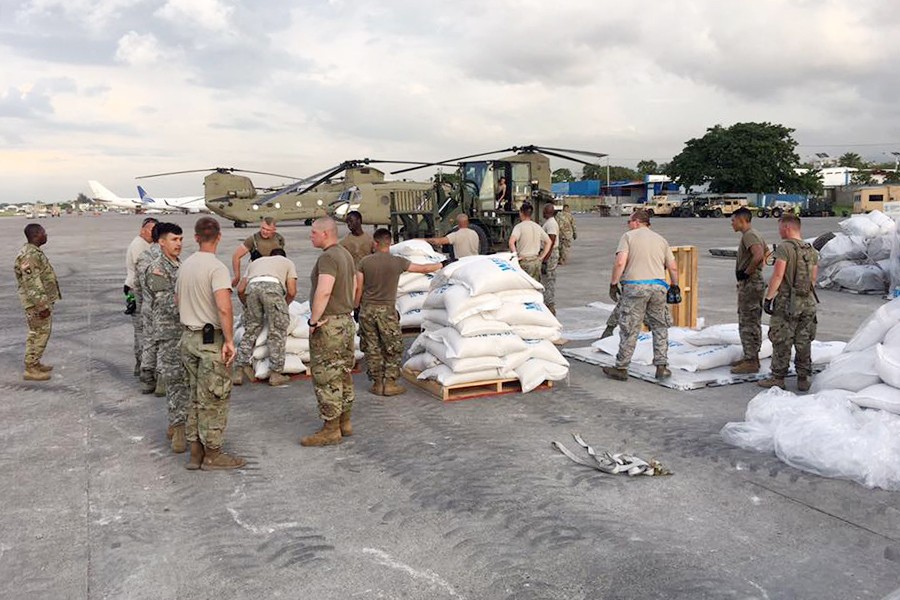
  • The Army leverages its unique capabilities—including rapid regional and global deployment, specialized engineering, and advanced medical and scientific teams—to provide immediate life-saving supports during regional or international humanitarian relief operations. 

Bridging three continents and a vast multitude of regional and military cultures, U.S. Army Europe and Africa stands as an indispensable guardian of peace and freedom, the pillars of security and stability, interconnecting Africa, Europe and the United States.

Get the latest news from  U.S Army Europe and Africa


Acknowledgments: Video; U.S. Army Europe and Africa/DoD, 2025. Article by Catherine S. Schmidt, Editor in Chief.

OPERATION CHRISTMAS DROP 2025 led by U.S Air Force

NATO Summit 2025

With the participation of a large number of NATO allies and partner nations’ heads of state, representatives, the official from defense and diplomatic ministries, various media and organizations, the NATO summit this year took place from June 24-25 in The Hague, The Netherlands.

The NATO 2025 Summit served as a pivotal event– reaffirming the alliance’s commitment to bolster its collective defense and strengthen the transatlantic partnerships.

Primary Accomplishment

Initiated by President Trump, the summit yielded a groundbreaking consensus on advancing the defense expenditure, as allies ratified a new comprehensive defense investment plan, elevating it to 5% of GDP by 2035.

The augmented investment will be instrumental in materializing NATO’s central objectives including:

  • Enhancing deterrence and defense capabilities,
  • Improving crisis prevention and management strategies,
  • And fostering cooperative security initiatives.

In today’s volatile and evolving geopolitical landscape, a strong, united and adaptable NATO that stands as a leading and a resilient force, is not merely necessary for the transatlantic security and defense but equally essential for global peace and stability.

Additional:


Acknowledgments. Sources: NATO. Image-1 President Trump and U.S delegation with NATO Secretary General Mark Rutte at the NATO Summit 2025. June 25, 2025 © NATO /Photo by Martijn Beekman. Article by Catherine S. Schmidt, Editor in Chief. 

ISRAELI ARMED-FORCES AND ITS MULTICULTURAL SYSTEM-2

The State of Israel and its Armed-Forces have one of the most open multicultural political and military system.  The history of Holy Land can attest this fact, by having its 8th President an Iranian immigrant Moshe Katsav,  only a few years ago.

With the encouragement of PM  Benjamin Netanyahu  and religious leaders like Greek Orthodox Priest Father Gabriel Nadaf  more young Arab and Christian are joining the Israeli Armed-Forces, for a better life and future. 

The number of christians and Arabs serving in the Israeli Defense Force is increasing every year. 

“The traditional view of the Arab-Israeli conflict is of Jews fighting Muslims. But that image does not always reflect the truth. 

In fact, there are thousands of Muslim Bedouin who serve in the Israeli army, or IDF, and even bear arms against their fellow Muslims in the occupied West Bank and Gaza.”  Rachid Sekkai BBC Arabic Service, northern Israel. October 20, 2009

  1. Additional: Increased Coordination Between Israeli Armed-Forces and the Palestinians for Celebration of Christmas Season
  2. Thousands of Muslim serving in Israeli Army.  The Israeli Army does not publish statistics numbers of the non-Jewish enlisted soldiers. However it says hundreds of non-Jewish Israeli citizens – Muslims, Christians and Druze – join the IDF every year. by BBC documentary   


Acknowledgments: This article was originally published in October 2016 on U.S.Europe World Affairs and in PCDN Global Think Tank in the U.S. Article by Catherine S. Schmidt, Editor in Chief. 

« Older Entries