US ARMY NATO Brigade

May 2023
Special Edition Interview with U.S Army NATO Commander (Series-1)
Special Edition Interview with Col. Troy V. Alexander, U.S Army NATO Commander, conducted by Editor in Chief, Catherine S. Schmidt
Q 1: U.S Army NATO is the Army’s support element for 44 NATO organizations across 81 locations in 22 countries. Can you give us a broad view into USANATO Brigade?
 Col. Troy V. Alexander, U.S Army NATO Commander: Since GEN Dwight D. Eisenhower first established this organization in December 1950, our job has been to provide training, logistics and human resources to produce ready and resilient Soldiers (and families) for NATO Land Force organizations across the alliance. We have four categories of personnel based on the type of assignment.
About 80% of our formation (over 800 folks) are what we call Peacetime Establishment, or PE Soldiers, directly assigned to 38 NATO warfighting and support organizations in 20 countries. Some examples of these types of organizations include Joint Forces Command Brunssum, NATO Rapid Deployable Corps – Spain, 1st German-Netherlands Corps, the CBRN Centre of Excellence in Czechia, the Joint Warfare Centre in Stavanger, Norway, and the 2nd NATO Signal Battalion in Naples. These Soldiers work directly for their NATO chain of command filling key leader and support roles across the alliance.
We also have 70 Military Personnel Exchange Program (MPEP) and Schools of Other Nations (SONs) Soldiers at 60 locations in 12 countries. They support cooperative security program objectives to build partner nation capacity, strengthen relationships, and increase confidence and security measures across the Alliance. Our MPEP’s are exchange Soldiers between the U.S. Army and similar units in NATO militaries. Schools of Other Nations Soldiers are assigned to national level NATO military schools like those in the United States. A great example is the professional military education program taught at Ecole Militaire, in the heart of Paris.
Supporting our geographically dispersed cadre of warfighters and exchange officers are a 250 strong contingent we call National Support Element Soldiers, stationed mostly in Italy, Germany and Belgium. The primary purpose of the NSE Soldiers is to ensure PE, MPEP and SONs meet individual readiness requirements and to help ensure resources are available to meet the needs of their families, including housing, medical and quality of life. We are also currently building deployable forward area warfighter support teams at the Headquarters, to provide agile and responsive Administrative Agent support to meet any emerging readiness and combat support requirements in this dynamic and rapidly changing theater of operations.
Q 2: In early February U.S soldiers in the NATO Rapid Deployable Corps visited the Spanish Army’s 1st Military Police Battalion. What inspired this visit? And how do you describe the collaboration and the partnerships between the U.S. Armed Forces/ USANATO Brigade and Spanish military?
Col. Troy V. Alexander, U.S Army NATO Commander: Our visit to the Spanish Army’s 1st Military Police Battalion was conceived and organized by the U.S. Senior National Representative at NRDC-Spain, Col. Jerzy Zubr, who sought to strengthen bi-lateral and multi-national relationships and give U.S. Soldiers an opportunity to learn more about the battalion’s unique capabilities. Their objective was to witness the agility and dedication of Spain’s military police maneuver forces and bring that knowledge back to better integrate it into contingency response planning. The visit was an effort to strengthen bonds, and the long-standing relationship with a key strategic ally.
For more than 60 years, the United States and Spain, along with our other NATO allies, have maintained a mutual commitment to regional peace and stability. No nation can confront today’s challenges alone. As the European security environment continues to shift in response to illegal aggression and malign influence, the U.S. continues to develop interoperability and cooperative capabilities to deter aggression…or if called upon, restore the peace. This visit was another example of our deep commitment to maintaining a strong and unified Europe. Ready, capable and stronger together.
Q 3: Can you discuss the Multinational Exercise Loyal Leda 2022 and the crucial role that the U.S. Soldiers held in it?
Col. Troy V. Alexander, U.S Army NATO Commander: Exercise Loyal Leda is one of NATO’s most important annual combat readiness evaluation exercises, and our Soldiers were embedded at every echelon of the NATO command structure, serving alongside of over 700 service members from 25 NATO and partner nations at the Joint Force Training Centre (JFTC) in Bydgoszcz, Poland.
At the heart of Loyal Leda 2022 was the JFTC-led Exercise Control (EXCON) headquarters, commanding and controlling thousands of troops across Europe in an Allied Land domain campaign exercise. The exercise was based on a compelling Article 5 scenario that encompassed a wide range of modern warfare challenges, including space and cyber domains, as well as hybrid warfare.
Its successful execution would not have been possible without the tremendous support of various commands, such as Headquarters Supreme Allied Command Transformation, Supreme Headquarters Allied Powers Europe, NATO Allied Air Command, Joint Force Command Brunssum, United States Army Europe, NATO Rapid Deployable Corps Spain, U.S. Army V Corps, NATO Communications and Information Agency, U.S. Navy Reserve, numerous MODs and more. Bottomline is that Loyal Leda delivered new levels of cohesion, a center of gravity for NATO adversaries. Opportunities like this, which improve and strengthen our capabilities and partnerships, continue to reinforce why NATO is the most powerful alliance on the planet.
Q 4: U.S Army NATO Brigade hosted consolidated readiness training for Europe-based military personnel exchange soldiers, in November 2022. Announced by USANATO Brigade ‘the U.S. Army NATO Brigade provides support to 55 MPEP Soldiers at 44 locations in Belgium, France, Germany, Italy, the Netherlands, Poland and the United Kingdom’. What categories of the exercises were parts of those readiness training?
And please tell us about the main responsibilities that the U.S Army NATO Brigade has within the Allied Forces North Battalion, and the Allied Forces South Battalion?
Col. Troy V. Alexander, U.S Army NATO Commander: During the event, we focused on individual readiness training for MPEP Soldiers to ensure they met U.S. Army deployment readiness requirements. The event also gave the cadre the opportunity to exchange best practices, and work with the USA NATO headquarters staff to recommend improvements to the MPEP program. With deployment training complete, our MPEPs were once again free to work with their various partner-nation organizations to deploy and support movements without restrictions, to a variety of local, national and regional exercise events. In the short few months since our MPEP training, our Soldiers have already led the Germany Army’s 1st Airborne and 23rd Mountain Brigade’s to Alaska for Artic Training at Joint Base Elemendorf-Richardson and certified the Italy’s Garibaldi Brigade during exercise Pegaso 22-4, in preparation to join NATO’s Joint Rapid Reaction Force this year (to name a few efforts).
Our Allied Forces South Battalion and Allied Forces North Battalion are responsible for providing support to PE Soldiers and their families across Southern Europe/Eurasia and Northern/Central and Eastern Europe respectively. Most of the day-to-day execution to support PE Soldiers across the theater falls on the shoulders of these two battalions and their assigned companies. AFNorth commands four Army companies in Belgium, Germany and Poland, while AFSouth commands three Army companies in Italy and Turkey and one company in the United States. Together with the capabilities of the Brigade headquarters, this forms the National Support Element structure for USANATO.
Two Battalions, one Brigade. Steady! NATO Strong!
- More news from U.S. Army NATO Brigade
- U.S European Command
- U.S Army Europe and Africa
- U.S Air Force Europe-Africa
- The 7th Army Training U.S Mission to NATO
- U.S. Army Southern European Task Force, Africa
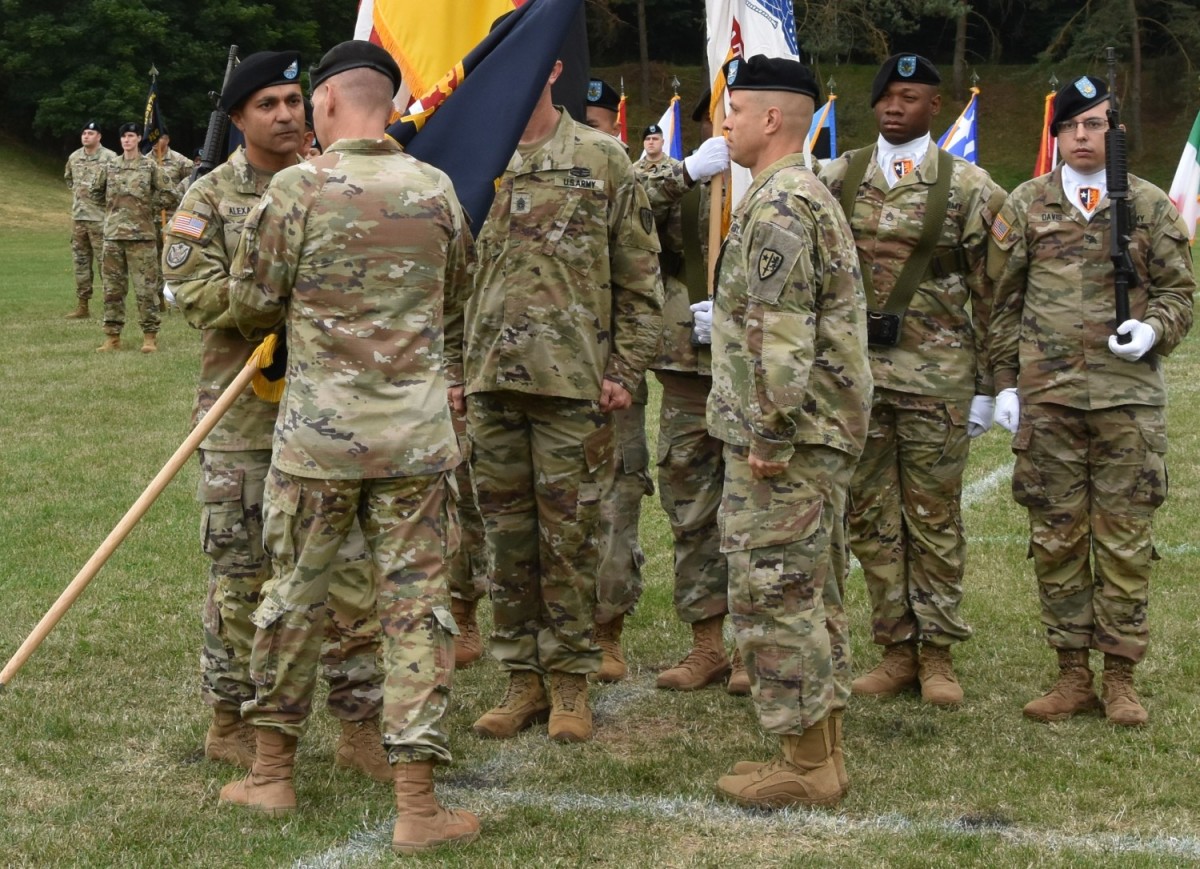
Acknowledgments: Image 1, Maj. Gen. Michael D. Wickman passes the U.S. Army NATO Brigade colors to Col. Troy V. Alexander during a change of command ceremony July 7, 2022 © Army. Interview is subject to copyright © U.S NATO Brigade/U.S Army Europe and Africa/U.S Army/ U.S Europe World Affairs.com
- Get updated from U.S ARMY NATO BRIGADE (Twitter)
- U.S Army NATO Brigade (Facebook)
-
The United States Armed Forces and its new Strategic Concept in Europe
While still the state and non -state sponsored adversarial threats are posing challenges to the security and stability of European landscape –the United States has audibly in many ways, reaffirmed its commitment to Europe. Albeit with the less number of its troops, yet with the deployable rotational forces, the U.S has promised… Read more
-
The Kingdom of the Netherlands and Israel an enduring partnership
On his official trip, Prime Minister Benjamin Netanyahu visited the Netherlands and met with HRH King Willem-Alexander at the Noordeinde Palace in the Hague and with Prime Minister Mark Rutte. The meeting was to bond a deeper political, diplomatic, innovation and economic relations between the two countries. … Read more
-
Royal Netherlands Navy in Operation Atalanta-4
The Royal Netherlands Naval frigate HNLMS Tromp, the flagship of EU NAVFOR since the August of this year, and the Spanish frigate ESPS Santa Maria also part of EU NAVFOR, came to friendly approach at Sea during their maritime patrolling in the Gulf of Aden. … Read more
-
U.S-European Armed-Forces fortifying their Capabilities-2
U.S-European Armed-Forces fortifying their Capabilities-2 (view the article/the video on the above link) Read more
-
U.S-European Armed-Forces in Exercise Swift Response 16
With more than 5000 soldiers and Airmen from 10 NATO Allied Armed-Forces, Swift Response 16 was one of the greatest multi-national military crisis response training for Airborne forces, led by 7th U.S Army Training Command Europe. The training was executed in Poland and Germany from May 27- June 26, with the successful outcomes. The Armed-Forces… Read more
-
Royal Netherlands Navy in Operation Atalanta-3
Launched in December 2008 under auspices of the European Common Security and Defence Policy, EU NAVFOR in Operation Atalanta is the first European Union Naval Force for countering the Piracy threats in the western Indian Ocean and the Horn of Africa covering 4,700,000 square nautical miles. A view to the… Read more
 US-Europe World Affairs