An exclusive interview with the Hon. General James B. Hecker Commander Allied Air Command, conducted by Editor in Chief, Catherine S. Schmidt
General James B. Hecker is Commander, Allied Air Command headquartered at Ramstein Air Base, Germany; and Director, Joint Air Power Competence Centre at Kalkar, Germany.
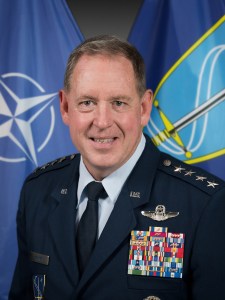 In his capacity as Commander, Allied Air Command, General Hecker is responsible to the Supreme Allied Commander Europe for the Air and Missile Defence of NATO Alliance member nations during peacetime operations. His command ensures the preservation of Alliance territorial integrity from Northern Norway to Southern Italy and from the Azores to Eastern Türkiye, including every European NATO nation. Furthermore, in the event of a joint NATO operation he is the responsible commander of the Air Component.
General Hecker is also Commander, U.S. Air Forces in Europe and U.S. Air Forces Africa. In this capacity, he commands U.S. airpower across more than 19 million square miles. This area also includes 104 countries in Europe, Africa, Asia and the Middle East, the Arctic, Atlantic and Indian Oceans, possesses more than a quarter of the world’s population, and generates more than a quarter of the world’s gross domestic product.
Honorable General, it’s a great privilege and real honor to have this interview with you. Thank you for your time, Sir.
With your permission I start the first question about the multinational live-fly Exercise INIOCHOS 24, which took place at Andravida Air Base in Greece from April 8 to April 18, 2024. What were the main objectives of this exercise?
Hon. Gen. James B. Hecker: Exercise INIOCHOS 24 offered a great opportunity for participants to fly complex missions, specifically designed to enhance interoperability and increase combat readiness. During the exercise, we covered the full spectrum of air operations including Air Power Contribution to Counter-Land and Maritime Operations and Combat Search and Rescue. Both offering live flying during composite air operations or COMAOs and using the Hellenic Air Force’s F-16 Tactical Simulators greatly enhanced achieving the participants’ training objectives. Participating crews (from Host Nation Greece and NATO members France, Montenegro, Romania, Spain, the United Kingdom, the United States and non-NATO members Cyprus, and Qatar) operated in a simulated complex and congested air environment with multiple modern threats and real-time live injects specially designed to enhance interoperability and increase combat readiness, building a stronger and more agile Alliance.
Later this year, the Hellenic Air Force will also host the NATO’s first Ramstein Flag exercise at the same Andravida Air Base. Organised by Allied Air Command, this multi-domain exercise will be the first iteration, exercising high-end sophisticated defence skills including; Counter Anti-Access/Area Denial (C-A2AD), Integrated Air and Missile Defence (IAMD) and 4th and 5th generation aircraft integration. The exercise will also combine use of the synthetic training environment to achieve its objectives. We’re doing a Ramstein Flag – similar to the U.S.-led Red Flag-exercise series in the United States, to provide that high end test and experimentation to NATO air forces. And this fits within a much broader, evolving picture of what our training and exercises needs to look like. We actually adapting out exercise program to make sure it prepares our air forces for contingencies and for better integration – that is why we embarked on this new Flag exercise series.
Q 2: March 2024 marked the 20th anniversary of NATO’s Baltic Air Policing Mission. Could you provide us with the overview of the challenges and the achievements that Allied Air Forces have encountered during these years? And how does this mission contribute to NATO’s overall defense strategy?
Hon. Gen. James B. Hecker: For more than sixty years, preserving the integrity of NATO airspace through 24/7/365 NATO air policing has been a collective task. All Allies have contributed to this enduring mission with air surveillance, command and control and – most visibly – fighter jets ensuring airspace protection and security within NATO Europe.
NATO’s Baltic Air Policing mission is one example of the regional arrangements; it has been executed since April 2004. For 20 years, Allies have worked together to preserve the integrity and safety of the airspace above the Baltic States. Since Estonia, Latvia and Lithuania joined NATO in 2004, the principle of collective defence has been rolled out to the Baltic states and Baltic Air Policing has epitomised the one-for- all-all-for-one promise, solidarity and cohesion among allies. Under that mission, Lithuania has hosted 64 consecutive rotations of Allied fighter jets safeguarding NATO’s airspace in the region providing credible deterrence and protection of NATO territory in the region.
And NATO is constantly adapting to the global security environment and Russia’s increasingly aggressive and violent behaviour. In 2014 – following Russia’s illegal annexation of Crimea – NATO activated Ämari Air Base, Estonia, as a second base for enhanced Air Policing in the region. In early 2022 – again in response to Russia’s brutal and aggressive war in Ukraine, NATO introduced enhanced Vigilance Activities and the Air Shielding mission. These efforts are aiming to strengthen air posture and provide additional Integrated Air and Missile Defence capabilities including airborne and surface–based systems to deter and – if required – defend NATO territories along the eastern flank.
We keep up these efforts on top of our 24/7 Air Policing mission. We demonstrate our capabilities, readiness and our steadfast commitment to collective deterrence and defence. On a daily basis, our Allied fighter jets flying over the Baltic Sea – that is now surrounded by NATO allies – are strong symbol of what our great NATO Alliance has represented for 75 years: a success story of an organisation that ensures collective security and promotes stability and peace for one billion people in 32 member states.
Q 3: From April 15- 17 NATO Air Command hosted the Agile Combat Employment or ACE conference with the participation of 25 members and partner states. Could you walk us through this conference and its key takeaways? Were there policy or operational recommendations?
Hon. Gen. James B. Hecker: I have established Agile Combat Employment (ACE) as one of my five priorities for NATO’s Allied Air Forces. The goal is to regain some of the agility and interoperability in how we maintain and support our aircraft. These are skills and knowledge we worked hard to develop and practice during the Cold War, but which we then did not maintain. Our work to progress ACE and supporting elements such as Aircraft Cross Servicing (ACS) is geared to correct this shortfall, increasing the survivability and operational effectiveness of our aircraft and systems while posing problems for our adversaries. During the various ACE conferences and symposiums AIRCOM hosts, we are establishing an operational concept to ensure Allies will regain their agility and interoperability in how aircraft are maintained, supported and operated under the full spectrum of joint operations. This also means that we must train and exercise like we fight – already in peacetime and make it part of the fabric of national education, training, planning, operations and future investment.
We have put a load of work into the ACE concept over the last one and half year. We have just released the first NATO ACE CONOPS. The salient statement is that no matter what nation you are from and what aircraft you are operating you need to be able to disperse your flying assets, service them, turn them around and unfold combat power at very short notice.
And you don’t have to have any aircraft to be an ace player, because if you have got an airfield, logistics support, force protection, or you’ve got a bunch of other things that will enable the overall NATO air power contribution, that is a powerful thing to bring which is critical support to the ACE concept.
We are testing some of it on smaller deployments and exercises and they are taking that CONOPS and running with it. We are certainly going to see more of that playing out over the coming months and years.
Once again, the war in Ukraine has highlighted the need to avoid being predictable and thus easily targeted. It has also exposed vulnerabilities demanding we develop the speed and responsiveness to deploy and redeploy as required.
Q 4: In the areas of strengthening regional security, rapid response and crisis management, as well as cyber defense and resilience what initiatives are on the table for the immediate future?
Hon. Gen. James B. Hecker: Let me elaborate on my five overarching Commander’s priorities for 2024 touching key areas for NATO Air and Space Power.
1. Counter-Anti Access/ Area Denial (C-A2AD). Our adversaries have studied our way in warfare for over 30 years, and they’ve learned that Air and Space power is the foundation on which everything else is built. Accordingly, they have sought to limit our access to the battlespace and to deny key operating areas to us. So one of the things we need to do is make sure that our defense has enough of offense in it as well. We need to take down the Surface to Air Missile systems and coastal defence cruise missiles that particularly limit our freedom of manoeuvre, and that of our navies and armies too. I’ve focused our primary efforts here, to ensure that all of NATO’s air forces can bring their best operational capability to ensure access in all domains, but especially air, land and maritime.
2. Integrated Air and Missile Defence (IAMD). To the extent that we need to dismantle our opponents’ C-A2AD capability, we also need to ensure we are able to defend NATO territory, its people, critical infrastructure, and essential defence capabilities. After over 30 years of relative peace in Europe and the opportunity to invest in other things, we now need to bring IAMD back to the forefront. AIRCOM have briefed at many events including senior NATO decision-making levels and engaged with all 32 nations’ air chiefs. We will continue applying considerable attention to IAMD to ensure we are able to defend every inch of NATO airspace as well as territory.
3. Air Command and Control (C2). There’s no point in having great capability – fighters, air defence missile systems, radars and munitions – if you’re unable to ensure they’re employed effectively. This requires an appropriately designed Air C2 systems approach, and hence C2 is another key priority. The war in Ukraine has also underlined the need for survivability, redundancy and the ability to operate when our communications and other things we’ve got used to taking for granted are denied us. We are looking hard at what this means now and in the very near-term – from how we train commanders and staff, through testing distributed C2, to the equipment that allows us to prosecute air operations at scale within increasingly complicated battlespace.
4. Information Sharing. Information sharing holds the most promise on return with the lowest cost, if we can overcome some important policy barriers. We need to ensure that our understandable but restrictive rules and processes guarding what information we can share with each other do not unnecessarily hold us back. To be sure, this is not just an issue for the US; we’ve all got restrictions on what we can share with each other. Each nation needs to assess and – where appropriate – overcome outdated and overly restrictive policy. One key example – the US now shares 3000 points of interest a month with NATO allies, previously it was 30 a month.
5. Agile Combat Employment (ACE). I have already talked about my fifth priority: To ensure we regain some of the agility and interoperability in how we maintain and support our aircraft. Let me reiterate that we need to work hard to apply ACE skills and knowledge in our operations. Once again, the war in Ukraine has highlighted the need to avoid being predictable and thus easily targeted. It has also exposed vulnerabilities demanding we develop the speed and responsiveness to deploy and redeploy as required.
Q 5: We would appreciate it Sir, if you could tell us also about the NATO Air Chiefs’ Symposium (NACS) which was hosted by AIRCOM on April 4th this year?

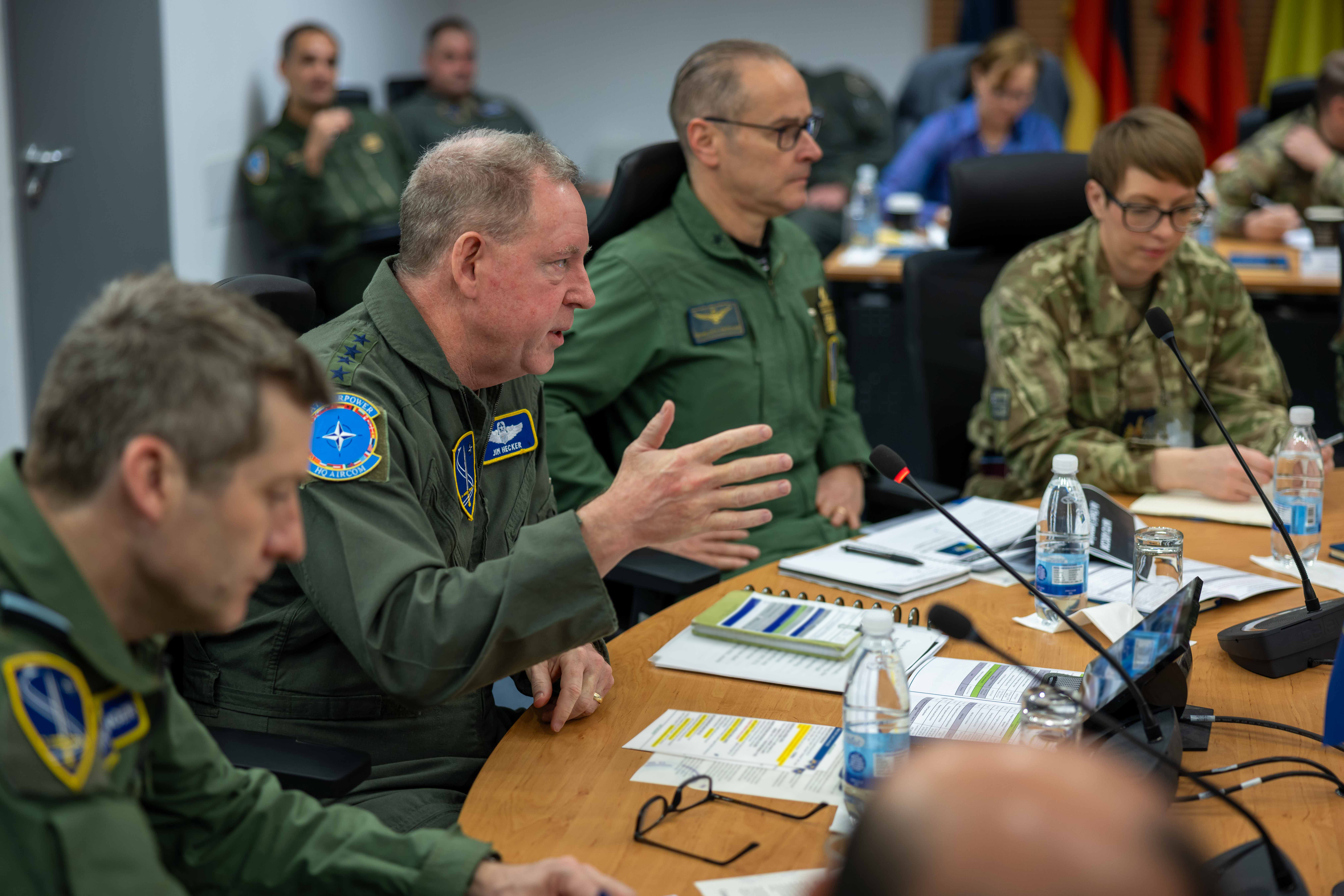
Hon. Gen. James B. Hecker: Allied Air Command has hosted semi-annual NATO Air Chiefs’ Symposiums for several years. During the first NATO Air Chiefs’ Symposium (NACS) in on April 4, 2024, we had senior leadership from the Nations, NATO and international organisations gathered the AIRCOM headquarters to exchange views, compare notes and discuss cooperation, coordination and development of Allied Air and Space Power. The Ukrainian Air Force Chief of Staff joint the deliberations via video teleconference. We seized the opportunity of having top representatives from the Allied air forces with us to commemorate the 75th anniversary of the Alliance in a brief ceremony underlining NATO’s long-standing tradition as a guarantor of collective security, peace and stability for more than one billion people in the 32 member nations.
Further to my top priority of integration by design, to NACS topic was focused on how to enhance integrated operations in NATO Air and Space Power. During the symposium participants underscored their steadfast commitment to the collective defence of all of NATO, and we agreed to continue developing Air and Space Power to support that bedrock of our Alliance. The successful integration of capabilities across the entirety of the Alliance is critical to continued deterrence and defence.
We also discussed matters related to the air fight in the joint campaign, Agile Combat Employment practicalities as well as Space Component development and requirements. One block of discussions focused on Integrated Air and Missile Defence lessons learned from the war in Ukraine.
Additional remarks by Hon. Gen. James B. Hecker Commander Allied Air Command on 75 years of NATO and 50 years of a NATO Air Command at Ramstein Air Base April 4, 2024
Today we celebrate the 75th anniversary of the strongest, most enduring and most successful Alliance in history – the North Atlantic Treaty Organisation – NATO.
On this day 75 years ago, the Foreign Ministers of twelve countries from Europe and North America, came together to sign the Washington Treaty and create our great Alliance.
Ever since, the vision articulated in its preamble continues to guide us saying that Allies “are determined to safeguard the freedom, common heritage and civilisation of their peoples, founded on the principles of democracy, individual liberty and the rule of law. They seek to promote stability and well-being in the North Atlantic area. They are resolved to unite their efforts for collective defence and for the preservation of peace and security”.
This treaty has kept our people safe through the long years of the Cold War, and when it ended, NATO helped bring two brutal ethnic conflicts in the Balkans to a close.
In 2001, after the 9/11 attacks against the U.S., for the first time, we invoked Article 5 of the Washington Treaty, which states that an attack on one Ally is an attack on all.
NATO has been on the front line in the fight against terrorism ever since. 2014 was another turning point. Since then, we have undertaken the biggest reinforcement of our collective defence in generations.
Today – at 32 member Nations – NATO is bigger, stronger and more united than ever. Together, we have helped to spread peace, democracy and prosperity throughout Europe in a trans-Atlantic context. From its founding 75 years ago, building bridges and working towards consensus in collective security in post-World War II times, NATO has had a historic record of success and relevance.
Today, 75 years later, NATO is built on an enduring commitment to our shared values and our ability to adapt to emerging challenges. We celebrate our collective history of military preparations, innovations, and operations.
NATO Air and Space Power has been a key contributor to collective security, deterrence and defence. For almost 50 years, an Allied command authority for air forces at Ramstein Air Base has supported NATO’s overall commitment to protecting its people, its common values and individuals’ security.
Since 1974, we have been delivering Air and Space Power to the Alliance, coordinating efforts with national Air and Space Forces and honing Air and Space contributions to collective security, deterrence and defence.
I am delighted and proud that we can commemorate this historic moment of NATO’s 75th anniversary, demonstrating collective Air and Space Power; with the representatives from our member Nations and of course with the Allied Air Command team of fine airmen and women here at Ramstein.
Acknowledgments: With special thanks to Allied Air Command and U.S Air Force. Images and biography of Hon. Gen James B. Hecker Commander Allied Air Command ©NATO AIRCOM. Image-2 Hon.Gen.James B.Hecker in NATO Air Chiefs’ Symposium (NACS) April 4 2024 Ramstein, Germany. The Interview is subject to Copyright law ©NATO Allied Air Command/U.S. Air Forces in Europe and U.S. Air Forces Africa/NATO/ U.S European Command/U.S Europe World Affairs.


 US-Europe World Affairs