Category Archives: US-European Leadership

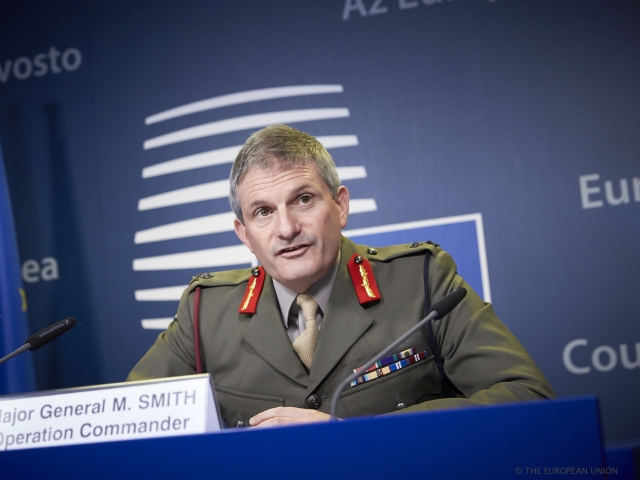
Interview with Major General Martin Smith, Operation Commander European Union Naval Force Somalia

An exclusive interview with Operation Commander of the European Naval Force in Somalia, Hon. Major General Martin Smith, on the legendary Triumph of the European Union Naval Force in ATALANTA, conducted by Editor in Chief, Catherine S. Schmidt

                                        Major General SMITH, Operation Commander of the EU Naval Force 2016Major General Martin SMITH, the Commander of European Union Naval Force in Operation Atalanta, during a press briefing in Brussels 2016 © European Union

Sir, it is real honor to have this interview with you. Thank you for accepting this invitation.

Q: The EU NAVFOR has achieved a resonating success, in its ongoing Operation. Yet the final outcomes requires a longer commitment of the EU Naval Force— that to imply the extension of its Mandate beyond 2016.

  • To what extend would you agree?

Major General Martin Smith: Over the coming months we will continue to work with WFP, Maritime Industry, counter-piracy partners, international organisations and regional states to assess the threat to shipping transiting off Somalia, and what type and level of security measures will be required post 2016 to ensure that piracy does not once again return to those waters. As you can see from a press release from the ‘Council of European Union’ Following a comprehensive review of this engagement, the Council confirms its intention to extend the mandates of the three CSDP  missions and operation until December 2018, with a view to further enhancing the EU’s Comprehensive Approach in Somalia and the Horn of Africa, in particular the security-development nexus. In this regard, the EU reiterates its resolve to implement as soon as possible its initiative for Capacity Building in support of Security and Development (CBSD).’

  • Please give us an overview of the Operational success up to present time.

Major General Martin Smith: At height of piracy in January 2011, 736 hostages & 32 ships were held from ransom.  As I speak to you today, there are still 26 hostages, but no ships are held.  If you look at factors such as intent, capability and opportunity, Operation Atalanta and the other counter-piracy task forces have, through close coordination, successfully deterred and disrupted pirates at sea and significantly reduced their opportunity to attack ships. 

The self-protection measures, Best Management Practice (BMP), employed by the Shipping Industry and their use of private armed security teams have also had a significant impact, as they have made it very difficult for the pirates to get on board and take a ship for ransom.

The legal process used by the EU to prosecute suspected pirates has also proven to be a notable deterrent, as pirates know that there could be a high price to pay if they go out to sea to attack ships. 

The EU operates a ‘detain and prosecute policy’.  We will always seek, where possible, a legal finish.  Legal handovers are made on the advice of the capturing nation’s Foreign Affairs Department and on the understanding that detainees would receive a fair trial and be treated appropriately. 

We assess pirates still have intent and capability, so International Community must remain vigilant.

Read more

The Netherlands EU Presidency and its Leadership in OECD

Logo kleur hoge resolutie Protected by Copyright Law The Netherlands-OECD Global Symposium on Financial Resilience Throughout Life’  in the Beurs van Berlage, Amsterdam will be opened by Her Majesty Queen Máxima.

This Symposium is a coordinated plan by the Organization for Economic Cooperation and Development  OECD and  the Dutch Money Wise Platform, from 20-21 April 2016

More news from Dutch EU Presidency:  International green deal with France, Flanders and the United Kingdom

Follow news from Prime Minister Mark Rutter

The Leadership of Netherlands in EU Presidency 2016

Logo kleur hoge resolutie Protected by Copyright Law


In 2016 the Netherlands holds the EU Presidency  for the twelfth time. The last time was in 2004.  Holding the Presidency involves mediating and brokering compromises between the 28 EU member states and between EU institutions like the Council, European Commission and European Parliament. The Netherlands’ central aim is that European Union place its focus more on what matters to Europe’s citizens, Economy and businesses. Thus its Priorities highlights Prosperity, Freedom and Security in Europe. 2016©The Dutch MFA

Among many areas that the Dutch Government  is intent on ameliorating in Europe– during its EU Presidency (until week  March 20, 2016) are:

*The list of touched Projects until week March 20th are far larger, but here are only a few.

The Netherlands’ initiative to enhance Europe’s Cyber-Security

“The Netherlands wants to unite Countries, Businesses, Think Tanks and internet Experts, so that the world will be better equipped to prevent Cyberattacks on Political or Military targets.” February 12, 2016 © Dutch MFA

‘Cyberattacks are the key threat of the future,’  ‘They target Countries, Individuals, Companies and Infrastructure Networks. The World is still too passive about this issue.’  highlighted Foreign Minister Bert Koenders.  February 12, 2016 © Dutch MFA        Continue to read

European CERT (Computer Emergency Response Team)

See also:   Report a Cyber Crime, EUROPOL

 Logo kleur hoge resolutie Protected by Copyright LawThe Netherlands EU Presidency 2016

The Leadership of Austria and its Armed-Forces in the World

Highly rich with European heritage, Austria is the centre of  Europe with its Capital city ‘Vienna’ the heart of Culture, History and Music, Literature, Science and Technology–since centuries ago.

In Political domain– Vienna holds also the key role not only in European Territory but also in the International Affairs. As of current time,  Vienna has the Seats of over 16 United Nations main Organizations, with more of other International Orgs and Institutions.  International Organizations in Vienna

In the Military sphere, the Austrian Armed-Forces has a major Leading Role in NATO, EU, UN Operations– deployed in various parts of the World for maintaining Peace and Security. 

A glimpse into the Austrian Armed-Forces engagements in the Global Missions

  • In KFOR Kosovo as part of International Security Force since 1999
  • In Bosnia and Herzegovina as part of European Force in Operation Althea since 2004
  • In UNIFIL Lebanon as part of UN Peacekeeping Force since 2011
  • In Central African Republic as the Military Adviser in EU Deployment Mission
  • In Ukraine part of OSCE as Military Observer in Monitoring Mission

Simultaneously in:

©Österreichs Bundesheer


By Catherine Stella Schmidt


Royal Netherlands Navy in Operation Atalanta-1

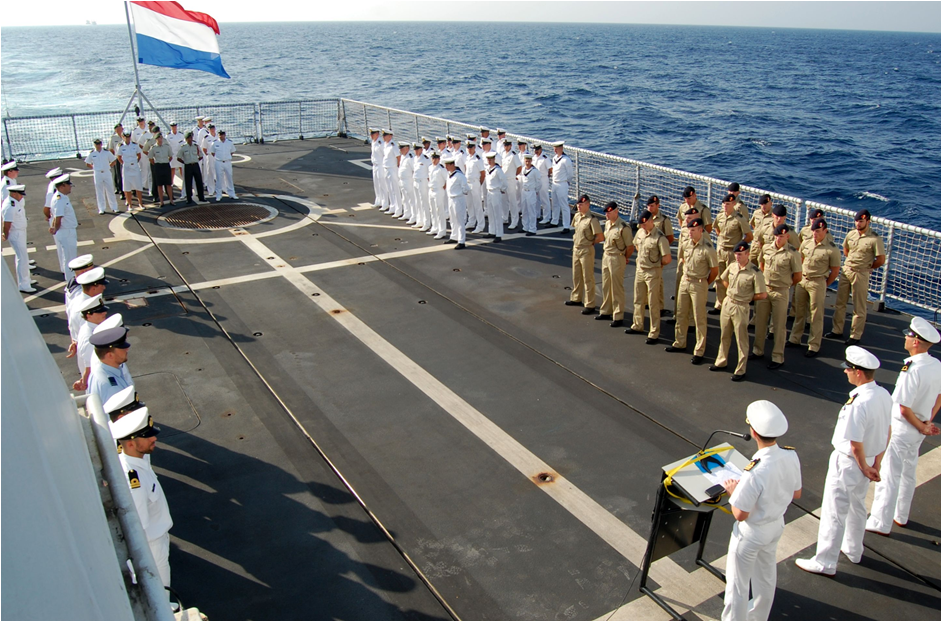
 The Royal Netherlands Warship Accomplished its mission in the Operation Atalanta

Dutch warship, HNLMS Groningen Nov.2015The Royal Netherlands Warship, HNLMS Groningen Friday 27 November ©EUNAVFOR

Since 2008, as  a vital part of EU Naval Force, the Royal Netherlands Navy has been greatly engaged in Operation Atalanta.  

In August 2015, for the first time, the Royal Dutch Navy deployed one of its golden Ace ‘Patrol Vessel HNLMS Groningen’ to EU Naval Force for the ongoing Counter-piracy ‘the Operation Atalanta’. 

In its leading position, the Royal Warship HNLMS Groningen was engaged in: Patrolling the regional water for  maintaining Security and giving protection to ‘ Food and Agriculture Organization of the UN’. And in  the Joint Training and Exercise with the regional Maritime Forces.

On November 27. the Royal Netherlands Warship accomplished its three months period mission and was awarded the Medal of Operation Atalanta.

In the Atalanta Medal Parade ceremony  ‘Commander Hansen’ the Commanding Officer expressed his gratitude to his crew and stated: “This Medal is a sign of the European Union’s appreciation of your good work and achievements.”  ©EUNAVFOR


By Catherine S. Schmidt (Copyrighted material) 


Interview with Minister Lucia Puttrich and her official visit to U.S Army European Command


Interview with H.E.  Minister Lucia Puttrich, Minister of European and Federal Affairs and Representative of the State of Hessen at the Federal Government of Germany, conducted by U.S Europe World Affairs Editor in Chief.


Your Excellency thank you very much indeed for accepting this interview. 

Q: You had an official visit at the end of August to U.S Army Center Europe. Please tell about us your general impression of the US Army in Germany, especially in regard with a great relations between die Bundeswehr and U.S Armed Forces.

H.E.  Minister Lucia Puttrich: My visit to the US-Army Europe headquarters in Wiesbaden was very interesting. We, as state government, have a close and trusting relationship to the US armed forces in Hessen. This is certainly due to a long history. We, as Germans, are very grateful to the USA that we were given the chance to rebuild our country according to democratic principles after the Second World War. For this, important decisions were made in Hessen. In 1948, the Hessian Constitution was signed at the Headquarter of the US armed forces and on July 1, 1948, the eleven West-German Minister-Presidents were given the mandate to prepare a German constitution.

The good cooperation, including in the civil-military area, is highly important for the safety of our citizens, especially in the face of present threats and challenges. Meeting Lt. Gen. Ben Hodges and his team convinced me of this [necessity]. Speaking about the good relationship between the Bundeswehr and the US Army here in Europe, it is of course remarkable that a Bundeswehr-General serves as chief of staff here in Wiesbaden. This is not self-understood but a strong sign for the importance of the German-American cooperation in this area.

 Q:  How the American presence in the South is received and welcomed by the local community.

H.E.  Minister Lucia Puttrich:  We, the people of Hessen, are open-minded and good hosts. We make sure that the soldiers, the civil employees and their families feel at ease here. Moving the European headquarters of the US army from Heidelberg to Wiesbaden is a sign for the good relations between the USA and Hessen. This was a groundbreaking decision of the US army with a highly symbolic character. The people of Wiesbaden and the people in the region have gained new neighbors with the relocation. We want to maintain the same close and good relationship we are presently enjoying. The people of Hessen have a strong welcoming culture.

 Q: What are the outcomes/benefit of this friendship between your government and great community in the south with the Americans.

H.E.  Minister Lucia Puttrich:  The German-American friendship also has a positive influence on the civil-military cooperation – not only with the US armed forces but also with the local command of the Bundeswehr. The trusting cooperation and the continuous exchange of information between the State Government, the ministry of the interior and the respective armed forces is remarkable.

News from:  U.S Army Europe and Africa         Hessen Government 

                                             follow us:          @USEUWAffairs   


Image:  U.S. Army Europe headquarters welcomed Minister Lucia Puttrich, the Hessian Minister for European and Federal Affairs, who met with Lt. Gen. Ben Hodges, Commander of Army Europe, and his staff.  August 24, 2015 Wiesbaden, Germany ©U.S Army 

References:  Strong Europe, German-US Military partnerships

Hessian Minister of European and Federal Affairs visits U.S. Army Europe


* The Interview is subject to Copyright Law.  All Rights reserved.

© Hessen government / US Europe World Affairs.com.  


The United Kingdom and the U.S in response to Syrian crisis

The United States and UK have been the two largest financial aid donor to the humanitarian crisis in Syria. 

Since the start of the internal conflict in Syria, the United States as the First largest financial aid provider, has contributed more than $4 billion to help the affected people and the refugees. Every months there is a new additional financial aid package by the U.S Government allocated in response to this crisis.

New U.S. Humanitarian Assistance to Respond to Syria Crisis, 21 September 2015

UK Humanitarian Help for Syria

At the same time UK and US with the initiative of la France have been trying to stop the civil war and to combat with the radical extremist groups in the region for years.

The United kingdom’s Leadership in refugee crisis in Europe

The result might have not been seen as the white and black outcomes– since there are more complexity involved in it, which comes mainly by those tyrannical systems that feed the radical groups either by weapons, other means of supports, or by blocking the UN Security Council’s decision by their veto– each time when the US-UK and France stood  resolutely to act in solving the Syrian internal conflict.

Please see the associated Official documents:

United Kingdom’s humanitarian aid in response to the Syria crisis, fact sheet by September 2015 by UK Foreign Office 

The UK will step up with nearly £115 Million in additional Emergency Funding in response to the migration crisis, Prime Minister David Cameron announced, 23 September 2015

Prime Minister David Cameron visits Lebanon and outlines details of the extra £100 million package to help Syrian refugees, 14 September 2015

The U.S Humanitarian Assistance to Syrians, by Department of State 

The UN Security Council fails to adopt resolution on Syria, the United Nations July 2012  

Russia, China block Security Council referral of Syria to International Criminal Court, the United Nations May 2014


« Older Entries Recent Entries »