UK’s Leadership in refugee crisis

Statement by Prime Minister David Cameron on Syria refugees and counter-terrorism

At the House of Common, 7. September 2015

Before making a statement on counter-terrorism, let me update the House about what we are doing to help address the migration crisis in Europe and, in particular, to help the thousands of refugees who are fleeing from Syria.

This issue is clearly the biggest challenge facing countries across Europe today. More than 300,000 people have crossed the Mediterranean to Europe so far this year. These people came from different countries under different circumstances. Some are economic migrants in search of a better life in Europe. Many are refugees fleeing conflict. And it is vital to distinguish between the two.

In recent weeks we have seen a vast increase in the numbers arriving across the Eastern Mediterranean from Turkey – more than 150,000 people have attempted that route since January. The majority of these are Syrian refugees – fleeing the terror of Assad and ISIL, which has seen more than 11 million people driven from their homes.

The whole country has been deeply moved by the heart-breaking images we have seen over the past few days. And it is absolutely right that Britain should fulfil its moral responsibility to help those refugees just as we have done so proudly throughout our history.

But in doing so we must use our head and our heart by pursuing a comprehensive approach that tackles the causes of the problem as well as the consequences.

  • It means stabilising countries where the migrants are coming from
  • It means seeking a solution to the crisis in Syria
  • It means pushing for the formation of a new unity government in Libya
  • It means busting the criminal gangs
  • It means saving lives using our aid budget
  • It means funding the refugee camps

Britain is doing and will continue to do all of these things.

  • We are using our aid budget to alleviate poverty and suffering in the countries where these people are coming.
  • We are the only major country in the world that has kept our promise to spend 0.7% of our GDP on aid.
  • We are already the second largest bilateral donor of aid to the Syrian conflict, including providing over 18 million food rations, giving 1.6 million access to clean water and providing education to a quarter of a million children.

And last week  we announced the largest an additional £100 million in aid taking our toal contribution to over £1 billion

The is the UK’s largest ever response to a humanitarian crisis. Sixty Million pounds of this additional funding will go to help Syrians still in Syria.

The rest will go to neighbouring countries – to Turkey, to Jordan, to Lebanon where Syrian refugees now account for one-quarter of the population. And over half of this new funding will support children, with a particular priority on those who have been orphaned or separated from their families.

No other European country has come close to this level of support. Without Britain’s aid to these camps, the numbers attempting the dangerous journey to Europe would be very much higher. And as my Rt Hon Friend the Chancellor said yesterday, we will now go much further in the spending review, significantly reshaping the way we use our aid budget to serve our national interest. We will invest even more in tackling the causes of the crisis in the Middle East and North Africa. And we will hold much larger sums in reserve to respond to acute humanitarian crises as they happen.

Britain is doing and will continue to do all of these things.

We are using our aid budget to alleviate poverty and suffering in the countries where these people are coming.
We are the only major country in the World that has kept our promise to spend 0.7% of our GDP on aid.
We are already the Second Largest bilateral donor of aid to the Syrian conflict, including providing over 18 million food rations, giving 1.6 million access to clean water and providing education to a quarter of a million children.

continue to read

 ©GOV.UK


The Czech Republic and NATO

 NATO Secretary General Jens Stoltenberg visited Czech Republic

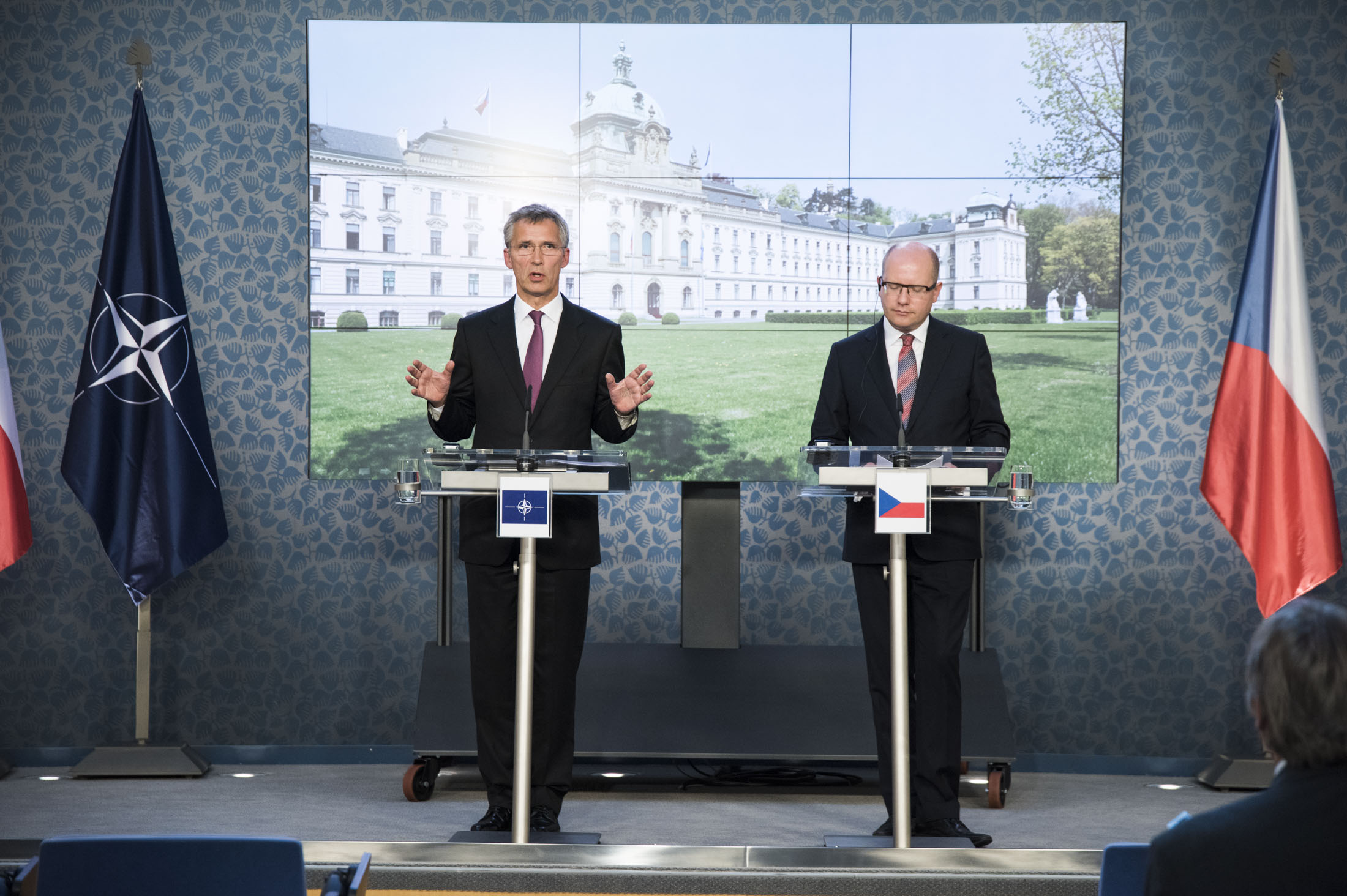
Joint press point with NATO Secretary General Jens Stoltenberg and the Prime Minister of the Czech Republic, Bohuslav SobotkaNATO Secretary General Jens Stoltenberg and the Prime Minister of the Czech Republic Bohuslav Sobotka. Prague 9.September 2015 ©NATO

During an official visit to Prague , on September 9th,  the Secretary General of NATO met with Prime Minister Bohuslav Sobotka, Foreign Minister Lubomir Zaorálek, Defence Minister Martin Stropnický, and other Officials.

Secretary General expressed his gratitude to Czech Republic for its continuous commitment and contributions to NATO and European Security, by spending 2% of GDP on  Defence :                                         “The Czech Republic is really contributing to our Alliance and collective Defence, and we are very grateful for that.”

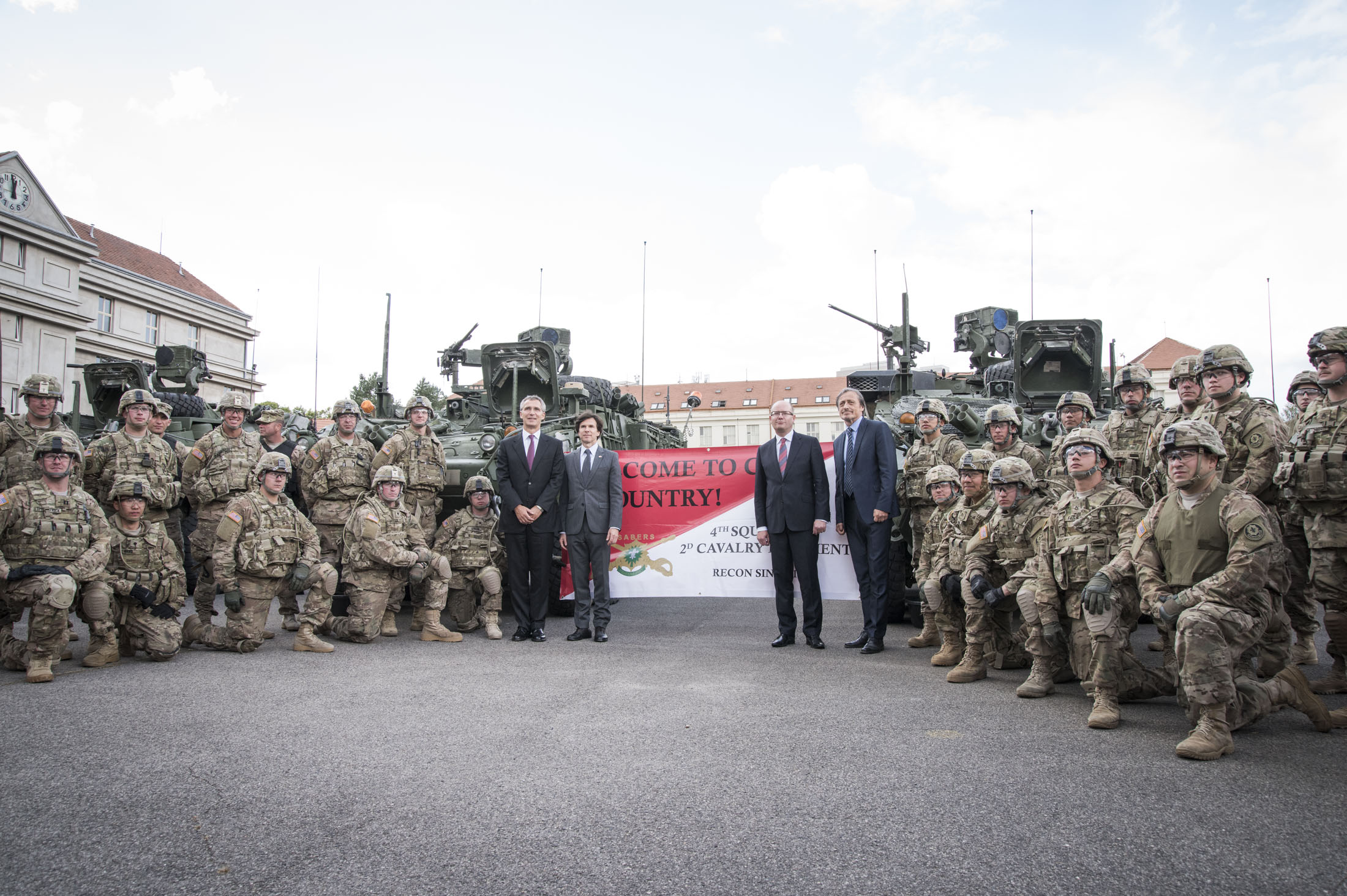
NATO Secretary General Jens Stoltenberg, the US Ambassador to the Czech Republic, Andrew H. Shapiro, the Prime Minister of the Czech Republic, Bohuslav Sobotka and the Minister of Defence of the Czech Republic, Martin Stropnicky with soldiers of the US military convoyNATO Secretary General Jens Stoltenberg with Prime Minister Bohuslav Sobotka, Minister of Defense of the Czech Republic Martin Stropnicky , the U.S Ambassador to Czech Republic  Andrew H.  Shapiro and the US Army Convoy. 9.September 2015 ©NATO

He also urged all NATO Member States to increase their investment on Defence and Security:  

“As  Security challenges grow, it is also vital that we invest more in our Defence.”


Europe needs one voice


In the mass influx of refugee crisis, all EU States need to remain in one voice and apply an objective strategic measures that could be sustainable in a long term.

In this scope United Kingdom, France, Poland, Czech Republic and Hungary are presenting the best solutions to the long term crisis.    As it is, evidently,  the German solution will not work for European problems.

In the frame work of European Union the crisis in our Territory need to be worked out with a team-work of all European governments, not a solo policy of one Land which could de-stabilize the others and the rest.  Hence Germany must listen to all EU States and act accordingly:

1- Protect its borders

2- Help other EU States to do the same

3- Deal with Crisis in Syria at the root just as France has declared yesterday.

Statement of the Heads of Governments of the Visegrad Group ( the Czech Republic, Slovakia, Hungary and Poland )

Press Conference by President Hollande (President de la Republique Francaise)

UK will work with UNHCR not the Human trafficking groups that have taken so many life.


By Catherine Stella Schmidt

On Transatlantic Relations: Europe and the United States

In a world, where environmental, economic and humanitarian turmoil, added to proliferation of Nuclear and Cyber threats are looming on the horizon, more than ever E.U and the United States must team up and strengthen their close relations.

More–
Research and Educational; Political and Legislation; Economic and Commerce; Military and Security integration will be necessary, as we face so many unknown elements of the 21st century.
The relation between Europe and the United States has not been established based on series of signed Treaties or economic agreements, but this is a relationship, which was born with the existence of the New World:
“The United States of America”
–and is cherished by Europe who sees this super power as a direct creation of its own thoughts and adventure.
Yes, we have roots and relatives on both sides, even though we might not be aware of them. Europe has been and remains to be so the United States real Heritage and its roots.
Every aspect of history and every fact attests that the EU-US relation is the most complementary and complete one.
Between Europe and the United States–
there is a relationship that can be only portrayed as an unconditional commitments, a sense of harmony and creeds that delve deeper than, it can ever be described, touching every aspect of their beings.
And this relation, will be always magnified with our common Ideals; values and principles; culture and our political thoughts.

At the Empirical level:
more facts, which could substantiate further the significance of Transatlantic Relations.
* Europe and U.S are account for over 50% of global GDP (the White House press release 2010).
* The E.U and the U.S have the largest bilateral investment and trade relations. The Transatlantic trade and investment amount to over $1 billion a day.
* Only in 2009, European capital was 64% of the foreign investment in United States.
* About 50% of U.S investment goes to E.U States as well.
(The White House press release 2010).
* In recent years the transatlantic direct investment has created over 14.million jobs on the both sides of the Atlantic (announced by the U.S Secretary of Commerce in 2010.
* As indicated by European Union in 2010 in the EU- US Summit, the United States remains the European’s largest trading partner for both goods and services.

From the crises and conflicts in various regions and countries: Africa, Asia, the Middle-East, Kosovo, Georgia, Afghanistan, while the U.N struggled to get the other Nations for the aid on its board, Europe and United States in almost all 20 and 21 century’s Peacekeeping operations, have shouldered the main parts of the economic and peacekeeping efforts, to de-escalate the Humanitarian crisis and the Global conflicts.

The United States and Europe, as the Pillars of Western Civilization, not only have led the World towards a greater transformation but also paved the path for the global journey towards Democracy, Freedom and Human Rights.
While these are solely a few aspects of EU-US relations, yet it has to be emphasized that in reality our History, Philosophy, Cultural and Political spheres are so much attached to each other– so much embedded by one, another, that the rest of the world sees us as one– on every front.
We have to recognize this importance.

Thus it is necessary to keep these ties as strong as ever for maintaining our global Security, Prosperity, and the survival of Western Civilizations, which alone stands on the Ideal of the Rights of Mankind and defending Humanity.


By Article by Catherine S. Schmidt, Editor in Chief. (Copyrighted Material) 

This article was first published in Europe’s World 2012 

The US and European Armed-Forces in a joint Exercise

Rapid Trident the U.S. Army Europe-led Cooperative Training Exercise

From 20-31 July 2015 the U.S Army in Europe conducted a joint Exercise with its European Counterparts. 

Rapid Trident, was part of U.S Army Europe that had its Training intensity on Peacekeeping and Stability Operations.

There were over 1800 members of Armed-Forces from 18 EU States as well as Canada.

Participating Armed-Forces were from:  Azerbaijan, Belgium, Bulgaria, Canada, Estonia, Georgia, Germany, Great Britain, Latvia, Lithuania, Moldova, Norway, Poland, Romania, Spain, Sweden, Turkey, Ukrainian and the U.S.


©The US Army Europe

By Catherine Stella Schmidt  (Copy righted material) 


United Kingdom and the EU Reform

Britain’s four-point package for EU reform

By the Foreign Secretary of the United Kingdom Philip Hammond

LONDON — Right across the continent, anti-EU parties have made huge gains in recent years — in local, national and European elections. We need to respond by making the EU more democratic and far better equipped to help deliver the growth and jobs its citizens expect.

Since the UK joined, the EU has changed beyond recognition. The fall of the Iron Curtain has seen the EU expand with 16 new countries becoming members; the Euro has been created, and EU rules now regulate our affairs across a huge area stretching from environment to social policy.

There is no doubt that EU membership has brought clear benefits to Britain in some areas. But in others it has led to loss of national sovereignty and an increase in bureaucratic burdens on business that has resulted in the British people’s consent for membership wearing wafer thin.
So what does the UK government want from this negotiation? To restore the confidence of the British people in the EU we need to work with our European partners to agree a package of reform that will ensure the EU is fit for the 21st century; reforms that will benefit not only the UK, but all 28 member states.

First, on jobs and growth, the uncomfortable truth is that the EU’s growth rate is far below that needed to reduce unemployment to acceptable levels and is being challenged not only by Asia, but also by the US. If we are to preserve European living standards, we need to empower our businesses to compete more effectively in the world by enhancing the single market, especially in services, digital, and energy. We have to be open to world trade and complete trade agreements with the US, Japan, and other developed economies, as well as with the fast growing economies of Asia and South America. And we must create a regulatory framework that supports, not hinders, business to create the growth and jobs we need.

Secondly, we seek reforms that will allow those countries that want to integrate further to do so, while respecting the interests of those that do not. This applies most clearly to the Eurozone where the UK does not seek to prevent further euro-integration — indeed supports it — but does need guarantees that the interests of those not in the euro will be protected. This concept of a two-pillar Europe, with a properly defined relationship between the Eurozone and non-Eurozone within a single market, and sharing the same institutions, builds on the existing architecture of Schengen and Banking Union and is good for everyone. It allows Eurozone integration to progress, respecting the interests of the non-Eurozone Member States. And it recognises that, while the concept of ever-closer union appeals to some Member States, it is not right for all.
Thirdly, we think national parliaments must have a greater say, both in connecting citizens to EU decisions and in properly implementing the concept of subsidiarity — the idea that decisions should be made as close as possible to the citizens they affect. All too often the EU has exercised power in areas where decision-making could be done at national, regional, or local government level without interfering with the operation of the single market or the effective functioning of the EU. We want to strengthen the role of national parliaments, for example, by allowing groups of them to be able to block regulations in future. The EU must respect the layers of government that are closest and most accountable to European citizens. We agree with the Dutch Government: “Europe where necessary, national where possible.”
Fourthly, while we accept that the free movement of people to work is one of the four fundamental freedoms of the EU and these negotiations do not seek to curtail this freedom, we do want to protect the UK’s welfare system from abuse and reduce the incentives that encourage highly skilled workers to travel to the UK to do low-skilled jobs. This undermines economic growth in their countries of origin and belief in the fairness of free movement in destination countries. We must also develop the other freedoms, in particular freedom of movement of services and of capital, to ensure that it is not just free movement of people that contributes to convergence of living standards across Europe.

We approach these reforms in a positive and engaged manner, listening to our partners and intending to agree reforms that will help all Member States to thrive in the 21st century.
We will negotiate a package of reform and will then ask the British people their view, in a straightforward “in or out” referendum by the end of 2017, and earlier if we can.

The stakes are high: the UK is a large and open economy with a long history and a significant role on the world stage which can contribute hugely to Europe’s success. If we can resolve the issues that have so troubled the British people and achieve a

“Yes” vote in the referendum, we will settle the question of Britain’s place in Europe and enable the UK to play a fully engaged role in a more competitive, prosperous, outward-looking and confident EU in the future.
That is an outcome that really will be in the best interest of Europeans on both sides of the English Channel.

This Article was originally published in Politico.EU on June 2015: http://www.politico.eu/article/britains-four-point-package-for-eu-reform/


Transatlantic-Relations

Transatlantic-Relations

March 9th, on his first Official trip, the President of the European Council Donald Tusk travelled to Washington DC to meet with President Obama and the U.S Congress for highlighting the importance of Transatlantic Partnerships, and to discuss various global crisis that are posing threats to the U.S and European Values, Security and Prosperity alike.
The two Leader also discuss the Transatlantic Trade and Investment Partnership (TTIP), Climate Changes, Energy Security, and the Fight against terrorism.

Welcoming President Tusk President Obama emphasized also the multifaceted deep partnerships between U.S-Europe and concluded by saying: 
                “Transatlantic Unity is as strong as it’s ever been.”

President Obama and the President of the European Council Donald Tusk, Washington DC 9 March 2015 President Obama during his meeting with the President of the European Council Donald Tusk, Washington DC 9 March 2015 ©Delegation of the European Union to the USA

Press statement by President Donald Tusk on the importance of US-European Partnerships and Unity.

Good afternoon.
First let me thank President Obama for inviting me, in my new role as President of the European Council, to Washington. Thank you, Mr. President.

We have much to discuss, however I would like to pay special attention to three topics, namely the critical relations with Russia in the context of Ukraine, the threat of terrorism and actions of the so-called Islamic State in the context of Libya, and lastly, our negotiations on TTIP, the Transatlantic Trade and Investment Partnership. Although these are three very different challenges, they have a common denominator, the need – maybe greater than ever before – for unity of Europe and the United States.
We are witnessing today the calling into question, attacking even of our fundamental values, freedom, prosperity, liberal democracy and geopolitical order. Our enemies who use propaganda, commit acts of violence and violate the sovereignty of our Neighbours want to weaken the political community of the Western world.

Today we can see with full clarity that they are trying to divide us, inside of Europe as well as Europe and America. But when we are united, we will be able to put a stop to the aggressive policy of Russia against her neighbours. The past has shown that when we were united, we were able to successfully fight against terrorism.

And also thanks to the fact that we have acted together in the field of liberal economy and free trade, we achieved success.
When it comes to TTIP, getting agreement will not be as difficult as people think. Of course the result of the negotiations must be balanced and we have to bring the public on both sides of the Atlantic with us but I have no doubt that TTIP will keep America and Europe strong in the world in terms of prosperity, growth and jobs, also with reference to geopolitical security.

Second, we need to prevent violent extremism from spreading in Africa. We must help Libya. We cannot have a failed state, run by warlords and fanatics, slipping into anarchy only 100 miles off the southern coast of Europe. Last, on Ukraine. We are united on the need for full implementation of the Minsk agreements and on our determination to maintain the sanctions on Russia until Minsk is fully implemented.
Brutal history has returned to us. History and the politics of faits accomplis.

That is why it is so important that Europe and the U.S not only speak in one voice but also that they act, in unison. Because who we are tomorrow depends on what we do today.

I deeply believe in some kind of Renaissance of faith in our Community. You, Americans, expressed this need in the most convincing phrase I know, United We Stand Divided We Fall.

Thank you.

©Delegation of the European Union to the USA


By Catherine Stella Schmidt  (Copy righted material) 


A view to U.S  European Command and its enduring partnerships with Europe

A view to U.S  European Command and its enduring partnerships with Europecombined-endeavor-2014


The opening ceremony of Combined Endeavor in Grafenwöhr, Germany 2014 ©United States European Command

Within the NATO and Transatlantic Relations the U.S European Command is working closely with its European partners:

  • To maintain Peace and Security in Europe;
  • To work with its European Allies in solving global issues;
  • To provide Diplomatic, Military and Humanitarian interventions in the crisis and conflicts zones, in order to prevent the up rise and escalations of them that could otherwise expand to Europe and to the rest of the world.

The U.S European Command also provides the largest and most prominent Military Training and Cultural Exchange Center, in partnership with die Bundeswehr, for Training, Updating, Joint Exercise and the Military Maneuvers. Most European Armed-Forces are taking part in these programmes.

It is important to note that up to present day, the European and especially German Armed Forces are the largest Military stationed in the United States for various Exercises and other Military liaisons exchange programmes.

There has been explicitly a great desire announced by the United States to welcome more in U.S, the European Armed-Forces for forming closer partnerships and joint Military programmes which could lead to the crystallization of NATO’s latest strategy on the Smart-Defence and the joint Forces.

The U.S Command in Europe, simultaneously, is engaged in other Missions:

  • Helping people:  helping to build self-sustaining capability in the Eastern Europe and other locations that are recovering from conflicts or war. 
  • And working with its European inter-governmental, International as well as NGO partners by providing Humanitarian and Financial assistance to help rebuild stability and prosperity for the conflicts or natural disaster affected Countries. 

The latest illustrative projects in the recent years are:

  • Help for flood relief in Poland, Serbia, Albania and Moldova
  • Water pumps in Serbia, Bosnia and Herzegovina
  • 44 school renovations, 28 hospital/clinic renovations and equipment upgrades, 33 emergency services/water related upgrades in Romania.


Article by Catherine S. Schmidt, Editor in Chief ( Copyrighted material)

This article was first published in Europe’s World in 2013.

The United States of America and Europe

Remarks by Ambassador O’Sullivan on EU-US Global Leadership as 2015 Priority

©Delegation of the European Union to the USA

Follow more news from the Ambassador


Legal Conditions
All the materials on US-EU World Affairs  including the media (articles, news, photos, videos, links) are from various Governmental Agencies and are strictly copy-righted. Redistribution, reproduction, copying, or linking the content of this organization, in any kind,
are prohibited by Law. 

All rights reserved.


Recent Entries »