Canada and its leadership on ‘World Press Freedom Day’

Statement by the Honourable Stéphane Dion, Minister of Foreign Affairs, and the Honourable Mélanie Joly, Minister of Canadian Heritage:

“Canada resolutely supports journalists, Human Rights defenders, bloggers and all others who use media platforms to promote inclusion and diversity, demand transparency and accountability from their governments, and ensure that the rights of all individuals are respected.

No person should ever be afraid to speak freely. No person should ever face intimidation, harassment, violence or death for voicing an opinion. 

According to a Freedom House survey, 2015 was the worst year in the past 12 for global press freedom.  On World Press Freedom Day, Canada recognizes the important role the media play in keeping the public dialogue vibrant. We also acknowledge the journalists, bloggers and activists who face censorship, imprisonment, and personal attacks as a consequence of carrying out their work, and we remember those who have lost their lives while exercising their right to report and speak freely.”  Press released  from Ministry of Foreign Affairs of Canada. May 3,  2016 – Ottawa, Ontario © MFA of Canada/Media Relations Office of Global Affairs

Follow news from Canadian Global Affairs

OSCE Chairperson-in-Office Foreign Minister Dr. Steinmeier on ‘World Press Freedom Day’

Germany’s OSCE Presidency 2016 Statement by OSCE Chairperson-in- Office Foreign Minister Dr. Frank-Walter Steinmeier on May 3rd  The World Press Freedom Day:

“Today, we pay tribute to journalists worldwide who brave violence, persecution and intimidation to record and report the truth.

Free, independent media are an indispensable cornerstone of free and democratic societies. The OSCE has a crucial role to play in setting and upholding common standards to promote this principle.
Times of conflict are, unfortunately, also times of propaganda and of distorted images. That is why as OSCE Chairmanship Germany is putting a special focus on freedom of the media and on how to ensure access to independent information in times of crisis.”  © Federal Foreign Office May 3, 2016

Follow news from Foreign Office
Follow news from Germany’s OSCE Chairmanship 2016

The United Kingdom’s Foreign Policy on promoting Human Rights in the World

The United Kingdom through its Political and Diplomatic stance, has been the strongest Advocator, the consistent Promoter and the uncompromising Defender of Human Rights,  and Freedom in the World.


FCO logo Copyright Protected by Law


On the importance of this concept in the UK Foreign Policy– Foreign Secretary The Rt Hon Philip Hammond elaborated:

The promotion of Human Rights is a core part of the everyday work of the Foreign Office and is the responsibility of British diplomats around the world. This year we are doubling the funding available for Human Rights projects to £10 million, through the Magna Carta Fund – a true measure of the importance we attach to this agenda.April 21, 2016 ©UK Foreign Office

The announcement by the Foreign Office states:

The Fund is launched on 18 January 2016 by FCO Minister Baroness Anelay which aims to further British interests overseas by tackling the root causes of Human Rights violations, strengthening institutions and governance, promoting and protecting Human Rights, and supporting Democracy and the Rule of Law.

The Fund has three priority themes:

 •Democratic values and the rule of law – Uphold universal rights, democracy and the rule of  law as key building blocks for more secure and prosperous societies;
•The rules-based international order – Support an effective rules-based international order that stands up for universal rights;
•Human rights for a stable world – Promote a more stable world by upholding universal rights in tackling conflict and extremism. April 21, 2016 ©UK Foreign Office

Additional References on the UK Foreign and Commonwealth Office to defend Human Rights and promote Democracy around the World:

Human Rights Internationally Report by the UK Foreign Office
The United Kingdom’s Human Rights and Democracy Reports

Follow News form The Foreign Secretary, Philip Hammond
Follow News from Foreign office

NATO Mission in Kosovo KFOR

NATO Mission in Kosovo KFOR, is a  Leading Force for Peace Support Operation in Kosovo since June 1999.

The Operation runs to bolster the  international efforts in establishing Peace, Security and Stability in the area.  And it was launched under the United Nations (UN Security Council Resolution 1244)  for the Peace Support Operation in Kosovo   in 1999.

Described by NATO Secretary General Jens Stoltenberg during his visit at the KFOR Headquarters in 2015:

                              “A professional and Capable Force. And a source of Regional Stability”

NATO KFOR 2015     August 2015 ©KFOR Public Affairs Office

The Operational Missions:

  • Contribute to a  safe and secure environment
  • Support and coordinate the international humanitarian effort and civil presence
  • Support the development of a stable, democratic, multi-ethnic and peaceful Kosovo
  • Support the development of the Kosovo Security Force

As of current time, approximately 5,000 Troops from the NATO-led Kosovo Force (KFOR), provided by 31 countries (23 NATO and 8 KFOR partners) continue to contribute towards maintaining a safe and secure environment and freedom of movement for all citizens, irrespective of their ethnic origin.

The HQ of KFOR is located at Camp Film City, Pristina under the authority of Commander of KFOR (COMKFOR)  MAJOR GENERAL Guglielmo Luigi MIGLIETTA  2016 © KFOR Public Affairs

Denmark the Frontrunner in the fight against Da’esh

Sponsor_Ministry_UK of Denmark protected by Copyright LAWThe Danish Parliament gave a milestone support for  Denmark to thrust ahead as a Frontrunner in the fight against Da’esh

On the occasion of this approval Minister Kristian Jensen stated:

“The fight against Da’esh is now entering a new phase. The global coalition has succeeded in denying Da’esh safe-havens and forcing the organisation back on the ground as well as disrupting its financial access and economic sustainment. But Da’esh still poses a major threat to the civilian population in the region – and to Europe through terrorist attacks and foreign terrorist fighters.  Therefore, we must increase the Military pressure on them.” Continue to read

 Described by the MFA, Denmark currently contributes to the fight against Da’esh  in three fields:

  • Redeployment of a F-16 Fighter jet contribution, consisting of four operational F-16 fighter jets and up to three in logistical reserve. This contribution includes up to approximately 110 people. The fighter jet contribution will available for the full spectrum of air operations.
  • A Contingent comprising Special Forces of up to approximately 60 persons.
  • A C-130J tactical air transport aircraft contribution comprising up to approximately 60 people, depending on the specific location and the ability to draw on existing support functions.  April 19, 2016 ©MFA Denmark 

I am pleased that a large majority has voted for the extended Danish Military engagement against the terrorist organisation Da’esh. With the broader mandate we will be able to fight Da’esh across the border to Syria leaving them nowhere to hide. It is important that we continue the fight and push even harder as they are currently being pushed back.

The Danish Military capabilities are in high demand and it is without doubt that our Soldiers are highly professional and well trained. I have the highest respect for their enormous dedication both previously and currently and I am confident that they will deliver on a high level during the coming deployments as well.”  affirmed Defence Minister Peter Christensen. April 19, 2016 © MFA Denmark 

The UK Royal Navy and its Global Leadership

The United Kingdom, with the longest Naval history at Seas and the Oceans from the 9th century onwards, has an exceptional role– an eminent  Leadership to exert in European Naval Force in  Operation Atalanta, the EU Naval Force in Operation Sophia, in the NATO’s counter-piracy Mission  Operation Ocean Shield and in recent NATO Operation in the Aegean Sea.

The Main Missions of the Royal Navy

  • Providing Security at Sea
  • Fostering International l Partnerships
  • Preventing Conflict
  • Maintaining the Readiness for Deployments
  • Protecting the Security of Transportation for UK, Europe and the Allies
  • And the Humanitarian Relief Operations

The Royal Navy in fostering International Partnerships

2014 © UK Royal Navy


Interview with Major General Martin Smith, Operation Commander European Union Naval Force Somalia

An exclusive interview with Operation Commander of the European Naval Force in Somalia, Hon. Major General Martin Smith, on the legendary Triumph of the European Union Naval Force in ATALANTA, conducted by Editor in Chief, Catherine S. Schmidt

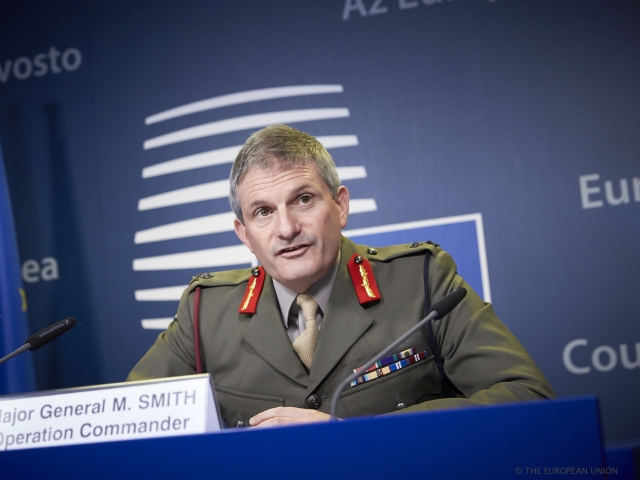
                                        Major General SMITH, Operation Commander of the EU Naval Force 2016Major General Martin SMITH, the Commander of European Union Naval Force in Operation Atalanta, during a press briefing in Brussels 2016 © European Union

Sir, it is real honor to have this interview with you. Thank you for accepting this invitation.

Q: The EU NAVFOR has achieved a resonating success, in its ongoing Operation. Yet the final outcomes requires a longer commitment of the EU Naval Force— that to imply the extension of its Mandate beyond 2016.

  • To what extend would you agree?

Major General Martin Smith: Over the coming months we will continue to work with WFP, Maritime Industry, counter-piracy partners, international organisations and regional states to assess the threat to shipping transiting off Somalia, and what type and level of security measures will be required post 2016 to ensure that piracy does not once again return to those waters. As you can see from a press release from the ‘Council of European Union’ Following a comprehensive review of this engagement, the Council confirms its intention to extend the mandates of the three CSDP  missions and operation until December 2018, with a view to further enhancing the EU’s Comprehensive Approach in Somalia and the Horn of Africa, in particular the security-development nexus. In this regard, the EU reiterates its resolve to implement as soon as possible its initiative for Capacity Building in support of Security and Development (CBSD).’

  • Please give us an overview of the Operational success up to present time.

Major General Martin Smith: At height of piracy in January 2011, 736 hostages & 32 ships were held from ransom.  As I speak to you today, there are still 26 hostages, but no ships are held.  If you look at factors such as intent, capability and opportunity, Operation Atalanta and the other counter-piracy task forces have, through close coordination, successfully deterred and disrupted pirates at sea and significantly reduced their opportunity to attack ships. 

The self-protection measures, Best Management Practice (BMP), employed by the Shipping Industry and their use of private armed security teams have also had a significant impact, as they have made it very difficult for the pirates to get on board and take a ship for ransom.

The legal process used by the EU to prosecute suspected pirates has also proven to be a notable deterrent, as pirates know that there could be a high price to pay if they go out to sea to attack ships. 

The EU operates a ‘detain and prosecute policy’.  We will always seek, where possible, a legal finish.  Legal handovers are made on the advice of the capturing nation’s Foreign Affairs Department and on the understanding that detainees would receive a fair trial and be treated appropriately. 

We assess pirates still have intent and capability, so International Community must remain vigilant.

Read more

Die Bundeswehr in Operation Atalanta-6

The German Navy has achieved 5000 Flying hours for EU Naval Force in Operation Atalanta

German-MPRA-Detachment-reach-5000-flying-hours-for-Op-Atalanta April 8, 2016The German Navy MPRA Team with the Bundeswehr’s Eagle P-3C Orion in Operation Atalanta, Djibouti. April 8,2016 ©EU NAVFOR

As a part of EU Naval Force  since 2008, the German Navy has been playing a crucial role in Operation Atalanta.  Its Naval Eagle P-3C Orion  flies regularly upon the Oceanic waves in patrolling the coast of Somalia for Maritime Reconnaissance, Transmitting the Intel to the Flagship, currently Frigate Bayern,  for the Force Commander to evaluate, determine and command the next stage.

On the achievement of imposingly successful– flying 5000 hours in the Operation,  the Commanding Officer of the German Maritime Patrol and Reconnaissance Aircraft ‘MPRA’ Detachment, Lieutenant Commander Kai Hansen,  elaborated:

“5,000 hours in the Air can only be achieved with a Strong Team. The cooperation between Crew, Technicians and Support Staff is excellent and means we can continuously contribute to the Success of the Operation.” ©die Bundeswehr/EU NAVFOR April 11,2016

                   Commander Hansen congratulates the BW Pilots for their reaching 8000 flight in EUNAV April 19,2016 Lieutenant Commander Kai Hansen congratulating the two the Bundeswehr’s Pilots for  their 8000 hours successful fly © die Bundeswehr/Christin Krakow. Djibouti, April 19,2016

Lieutenant Commander Kai Hansen,  also personally congratulated the two Bundeswehr’s Pilots from the MPRA Team, each with 4000 hours of successfully fly in the Operation Atalanta.


By Catherine Stella Schmidt

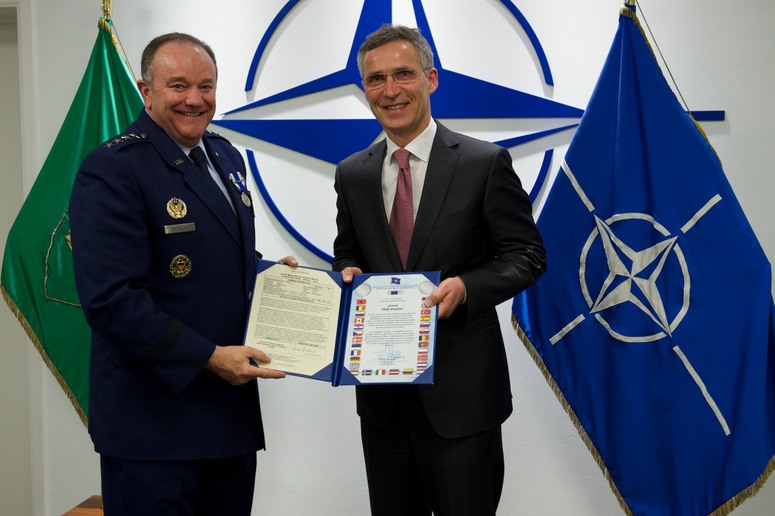
Supreme Allied Commander Europe General Philip Breedlove received NATO Meritorious Service Medal

The Supreme Allied Commander Europe, U.S. Air Force Gen. Philip M. Breedlove , received  NATO Meritorious Service Medal for his outstanding leadership.

Outgoing SACEUR General Philip Breedlove is presented with NATO Meritorious Service Medal by NATO Secretary General Jens StoltenbergSupreme Allied Commander Europe General Philip Breedlove and NATO Secretary General Jens Stoltenberg during the Award ceremony April 13 2016 © NATO

Gen. Breedlove assumed the position as the Commander of European Command and Supreme Allied Commander in  2013– during the high challenging time in NATO history after the cold war era. 

 Among many high caliber achievements of Gen Breedlove are his success in:

  • Bringing all NATO member States and Partners in a closer cooperation in the Collective Defense and Solidarity fronts
  • Upgrading the capabilities of most European Armed-Forces with the latest Defense Technology
  • Increasing the interoperability of the members of the Alliance
  • And Advancing, considerably, the degree of the Readiness and Responsiveness of NATO Forces on the Land,  in the Air and at Sea

As a result NATO is far more stronger, today,  than ever……

The United Kingdom’s Leadership in NATO

On April 14 NATO Secretary General Jens Stoltenberg travelled to London and met with Prime Minister David Cameron. The meeting incorporated discussion on range of issues  that are challenging Europe, the subject of Global Security and the Nuclear Proliferation. The two leaders also discussed on the upcoming NATO Summit in July

                         NATO Secretary General Jens and Prime Minister David Cameron April 2016April 14, 2016 © NATO

Secretary General Jens Stoltenberg highlighted that the World in a more unpredictable chart, NATO counts on the United Kingdom’s Leadership in addressing  these challenges and combating with the threats.  He also thanked United Kingdom for its crucial leadership in  NATO’s Collective Defense and the UK’s leading contribution to NATO which is the second to the U.S.

“NATO and the European Union are two organisations which are vital and which are working closely together in many different areas, and I would welcome even closer cooperation,” stated Secretary General  April 14, 2016 © NATO

In early March this year, Prime Minister Cameron announced an additional contribution to NATO’s recent Mission –by deployment of the Royal Naval Ship Mounts Bay in support of NATO Operation to the migrant crisis in the Aegean Sea

« Older Entries Recent Entries »