Category Archives: U.S Armed Forces in the World

The United States Navy in Operation Atalanta-2

US naval Europe Africa May 22, 2016


The United States Military Sealift Command  (MSC)  is a Military Naval Agency to support transportation for the U.S Navy at seas and oceans.   Its history goes back to the second world war– even though at that time the MSC was not established as the independent agency.  A few years later in 1949 the formation of  the Military Sea Transportation Service, as a distinguished agency,  was materialized to provide ocean transportation support for the U.S Department of Defense.     the-aircraft-carrier-uss-dwight-d-eisenhower-and-usns-john-ericsson-t-ao-194-us-navy


In the years followed the 1949,  the role of Military Sealift Command (MSC), developed and commenced to project itself more significantly.  Its operations continue to insert the vital support,  not only to the United States Navy but also for NATO Allies–encompassing from the Cold War era, the Gulf War, Iraq and Afghanistan missions– and to the most ongoing operations of the present time, inter alia, the  NATO and EU in the counter-piracy.

In the recent years with much synchronized joint efforts of the U.S and European Naval Forces in the various global missions, the MSC also has notably expanded its supporting tasks to the European Naval Forces. In this effort one of its main tasks is for Replenishment At Sea (RAS).  The recent MSC statistic report describes that at the present time there are approximately 110 ships on a daily basis operating on support mission across the globe.

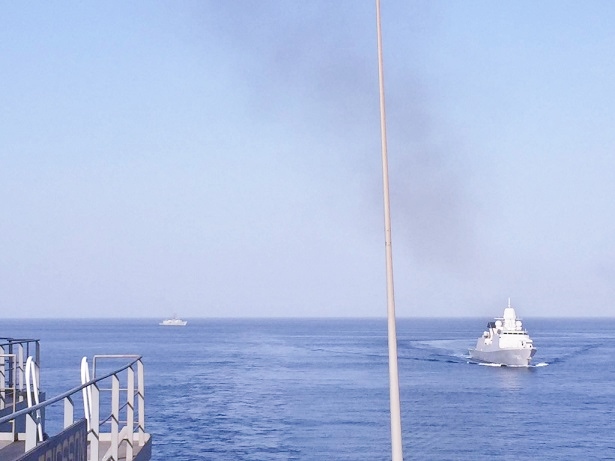
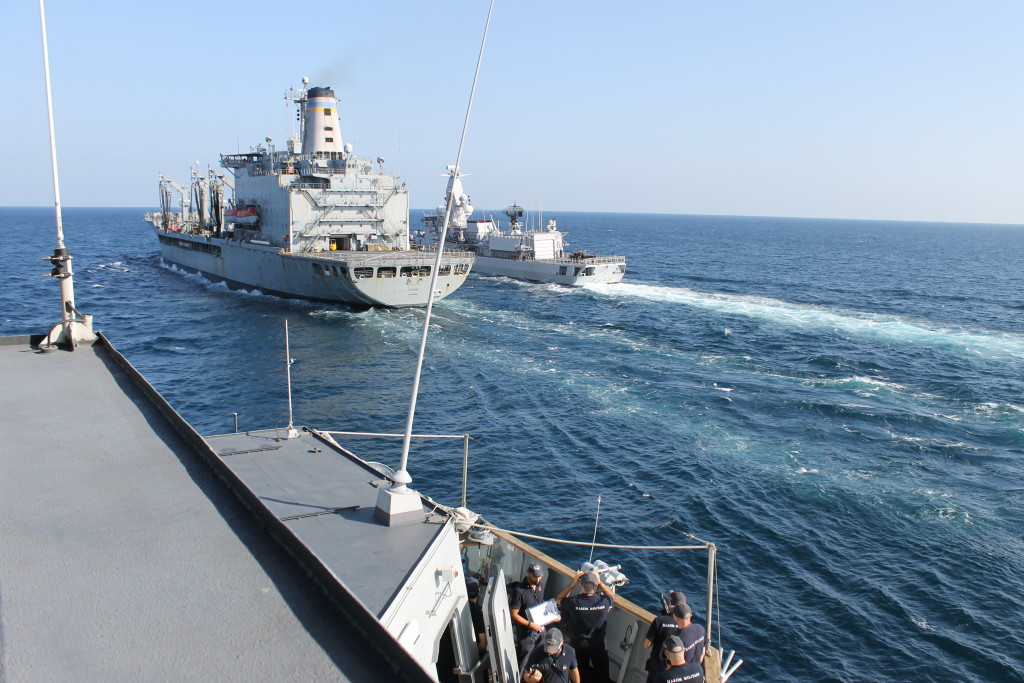
On August 30, the EU NAVFOR flagship HNLMS Tromp,  after intense days and weeks of maritime security operation in the Indian Ocean and gulf of Aden, had to be refueled for the continuation of its crucial mission at seas.                                                                                                                                                                               For that the U.S  fleet replenishment oiler  USNS John Ericsson  was tasked for administering the replenishment.   In the ensuing early hours of the day, the grand ship of  U.S Navy ……. had to reach the mathematically determined point to the Dutch frigate– for executing  ‘the Alongside Connected Replenishment’– on a rapid and precise mode.                                                                                                                

Shortly after–  the colossal ship drifted away….. and sailed  ……into distance for its next mission.          

Yet this was not the first,  nor will be the last,  that the Military Sealift Command of the U.S Navy stood as the vital lifeline for the EU Naval missions be it in any parts of the World, when urgency and support has been called.   Its role even though as the supporting task remained to be highly essential– for without MSC the continuation of any operations will not be possible, especially the maritime security  and the counter-piracy in the oceans.

hnlms-tromp-approaches-usns-john-ericsson-to-begin-refueling-august-2016


Frigate HNLMS Tromp (right) approaches USNS John Ericsson to be refueled. August 30, 2016 © EU NAVFOR   


  1. Additional:  The United States Navy in Operation Atalanta-1
  2. The USNAVAF and  EU  NAVFOR for the first contact between Operation ATALANTA  and the US Command responsible for the US Naval Forces in the Southern Indian Ocean.

Image-1:  The aircraft carrier USS Dwight D. Eisenhower (CVN 69) alongside the fleet replenishment oiler USNS John Ericsson (T-AO 194) in Arabian Guld. July 26, 2016  © U.S. Navy/Mass Communication Specialist Seaman Apprentice Joshua Murray.                                                         Sources: US Navy/EU NAVFOR. By Editor in Chief, Catherine S. Schmidt (Copyrighted material)  

The United States Armed Forces and its new Strategic Concept in Europe


While still the state and non -state sponsored adversarial threats are posing challenges to the security and stability of European landscape –the United States has audibly in many ways, reaffirmed its commitment to Europe.

Albeit with the less number of its troops, yet with the deployable rotational forces, the U.S has promised for a long stay, to defend and fortifies its European partners.

Coextending with that– the United States military has conceptualized a new strategic planning which empowers the U.S with the 30,000 troops, and the stepped up rotational forces, to maintain the same efficacy of 300,000 boots on the grounds.

With this new military concept of the Department of Defense formulated in the recent years as ‘The European Reassurance Initiative (ERI)’ signed by President Obama  in December 2014, the U.S conveys explicitly and forthright that its Armed-Forces will always be part of European allies and provide every assurance for European Security and Defense.                                    

With that the U.S Armed Forces in Europe has redefined its vision, role– reshaping its partnerships with the European counterparts into a new level of political and military proximity and closeness.

Under the same scheme, the U.S European Command has intensified, in the recent years, its engagement in preparing and upgrading the European Armed Forces from south and the Black sea to the northern European hemisphere the Baltic sea– to the highest military architectural format—effectively interoperable with the U.S military in any operational environments.

The new strategic planning in Europe encompasses a wide range of trainings, joint maneuvers and exercises which are formulated to increase:

  • The interoperability of U.S-European Armed-Forces;
  • Modernization of European military weaponry equipment, technology and technique;
  • Advancement and the upgrade of European military capabilities from air to the cyber- space.

The planning goes further with a special focus to bolster:

  • European capability for deterrence;
  • Their strength and their combat power, simultaneously.

This new concept and its wide-scope of applicable approach– has also inaugurated a new chapter towards the standardization of U.S-European Armed-Forces, enabling them to prepare and maintain the high readiness for countering the global crisis, in a curtailed frame of time yet with the most effective measures in place.

“We will be always going to be part of Coalition if not Alliance. All our best and most reliable Partners come from Europe whether NATO or Partnership for Peace Countries.  So the Chance  for practice with them is a great opportunity to continue to build the trust with them” Excerpts from the statement Commanding General of U.S Army Europe, Lt. Gen. Ben Hodges.  In the interview during the NATO Exercise, Norway March 2016.

By Catherine Stella Schmidt   (Copyrighted material)


‘Strong Guard 2016’ has concluded its Training

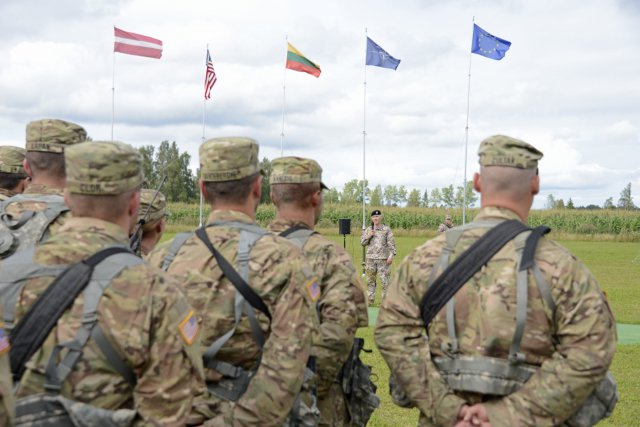
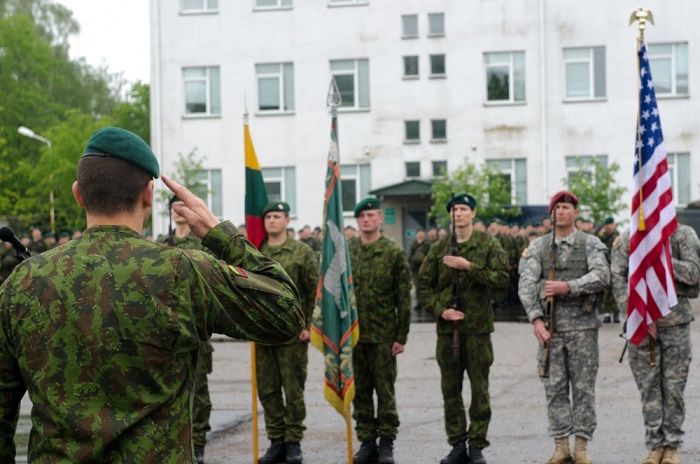
Exercise  Strong Guard 2016  was a unique US-European Military Training Exercise, executed during a three day time frame, to boost the close Partnership and the Interoperability of U.S National Guard, Military Police Battalion, Marines, with the Land-Forces and National Guards of Lithuania and Latvia. The Training was finalized successfully with a Military ceremony on August 14, 2016.

Reaffirmed by the U.S Army, “Strong Guard 2016 demonstrated the continued U.S. commitment to the security of the NATO Allies in the light of the increased tension in Eastern Europe.” August 2016 © U.S Army Europe

Military Police Battalion, 177th Military Police Brigade, Michigan National Guard EUCOM August 19, 2016


Military Police Battalion, Military Police Brigade, Michigan National Guard during the official closing ceremony of ‘Strong Guard 2016’  in Latvia.  August 14, 2016.© US Army/Staff Sgt. Kimberly Bratic

There were Soldiers, in variety of uniforms…… presenting their Brigades, Battalions, and Units– stood in salute in the closing ceremony.  In a normal day or an ordinary condition, after three days and nights of  heavy  Training, which had challenged the toughness of Minds and the strength of Physique beyond all limits–  one would had resigned before the finishing line and to exhaustion. But far from that– these were the Soldiers that have surpassed every extremes.  Standing firm, …..their eyes were radiating with the the heights of pride……, and strength was yet visibly depicted in every steps of their movements….. as they marched towards the Garrison at their Commander’s behest. 

News from Strong Europe US Army Europe                
News from US Naval Forces Europe-Africa
News from US Air Force Europe-Africa
News from U.S. Army Garrison Bavaria

Source: US Army Europe/Staff Sgt. Kimberly Bratic.  By Catherine S. Schmidt, Editor in Chief (Copyrighted material)

An Exclusive Interview with the U.S Army Europe-1

US naval Europe Africa May 22, 2016


In the Exclusive Interview Series, this time we have the special occasion of presenting our interview with the United States Army Europe. The interview has been conducted with the Team of Public Affairs of the U.S Army Europe HQ in Germany.


Q:  The United States and Europe are immensely interconnected, not only by Historical Heritage, Values and Ideals for centuries, but also by Political Landscape, Security and Defense.

  • Would you please elaborate on the importance of this Relation on the domain of Security and Defense.

Public Affairs of the U.S Army Europe HQ in Germany:  Our history is absolutely the foundation of what connects the United States and Europe. During the Warsaw Summit in July President Barack Obama said, “In this challenging moment, I want to take this opportunity to state clearly what will never change – and that is the unwavering commitment of the United States to the security and defense of Europe, to our transatlantic relationship, to our commitment to our common defense.”

Paratroopers from the 173rd Airborne Brigade join NATO Allies. US Army Europe May 2014

This is also the case for the U.S. Army’s role with our European Allies and partners. Although the security environment has dramatically evolved over the last 25 years, it is vital for us to continue to work and train with our Allies and partners. Multinational exercises like Swift Response, Anakonda, Inherent Resolve, Saber Guardian and other training opportunities benefit Army Europe Soldiers as well as our National Guard and Reserve components. We know firsthand that training with our Allies, partners, and NATO better prepares us all for future operational requirements.

Such operations and exercises provide our U.S. Army Soldiers with necessary training and valuable skills needed to operate in this theater. They also facilitate building relations with our Allies and partners, which is just as important. Everything we do should demonstrate to our European Allies and partners that we understand our responsibility and commitment to offer assurance.

Q: Strong Europe’ could you please illustrate this crucial aspiration of the U.S Armed-Forces in Europe and how the U.S Army present, project and implement this Concept?

Public Affairs of the U.S Army Europe HQ in Germany: By looking at the stories on our website, the content on our social media channels and following the coverage of the exercises, you will see that “Strong Europe” is not a catch phrase, it is a commitment.

This commitment is the corner stone of the framework that makes up everything U.S. Army Europe contributes on behalf of the Army, to EUCOM, AFRICOM, CENTCOM, and NATO. Europe is a complex and dynamic security environment that presents evolving challenges. With the contributions and capabilities provided by our Allies, partners and regionally allocated forces this strategic effect can be reached.

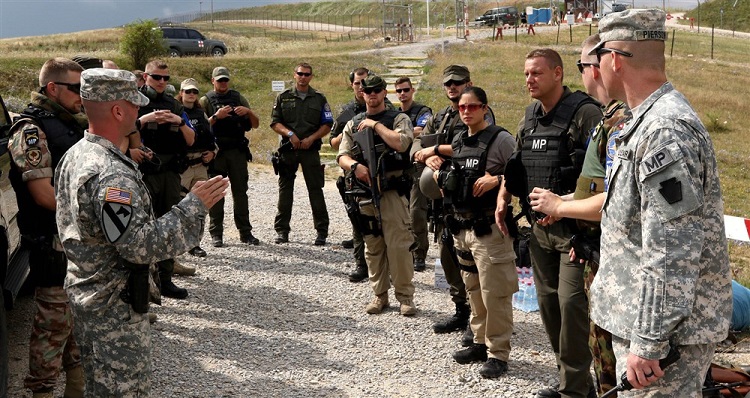
The Multinational Battle Group-East Military Provost Marshals office gives brief to NATO Forces Kosovo in Camp Bondsteel, Kosovo, July 26, 2016 EUCOM


U.S. Army Europe operates with five pillars to support our priorities. They are: Empowering Junior Leaders; Army Reserve and National Guard support; Allies and Partners; Regionally Allocated Forces; and Dynamic Presence. All of these components make up “Strong Europe”.

Read more

The United States Navy in Operation Atalanta-1

Besides conducting a variety of missions like training, maneuvers, and joint exercises with its global partners, the U.S. Navy also actively supports the European Naval Force’s Operation Atalanta.

This partnership is a demonstration of the United States’ broad commitment to international maritime security and cooperation.  

It simultaneously ensures:

·         The protection of global commerce;

·         Enforcement of international law;

·         The security and stability of the international waters;

·         And the enhancement of maritime capabilities of its global partners.


ITS-Carabiniere-approaching-the-USNS-Laramie-for-RAS December 2015 EU NAVFOR

One of the U.S main vessels in supporting the Operation Atalanta is the USNS Laramie. Equipped with chopper deck, the gigantic U.S Naval ‘Laramie’ is a Military Sealift Command Replenishment Oiler of HENRY J. KAISER Class, launched in 1995.

Since then, the ship has been on long-haul missions across the globe. From the Pacific to the Indian Ocean and the Mediterranean Sea to the Gulf of Aden, it has provided vital support to U.S. and European naval forces, including aircraft carriers, frigates, and patrol ships.

As a part of this ongoing Operational Support and the Replenishment at Sea, the USNS Laramie met in a close contact with the Operation Atalanta’s new Flagship, HNLMS Tromp  of the Royal Netherlands Navy on August 8th  2016, in the Atalanta’s Operational field, the Gulf of Aden.

The EU NAVFOR Operational Force Commander, Commodore Luyckx was welcomed for a visit by the Commanding Officer of U.S Naval Replenishment Vessel, Captain William Wiggins.


Follow us on the next episode:

The United States Navy in Operation Atalanta-2


Official references of the recent time:

  1. United States Navy Supply Ship Supports Operation Atalanta With A Combined Replenishment At Sea
  2. US Supply Ship USNS Laramie Supports Operation Atalanta off the Coast of Somalia
  3. US Navy Ship Supports EU Naval Force  Ships Off The Coast Of Somalia
  4. EU Naval Force Warship ESPS Infanta Cristina Carries out Replenishment at Sea with Supply Ship USNS Laramie
  5. EU Naval Force Warship ESPS Navarra has carried out Replenishment at sea (RAS) with re-supply tankers, including the US logistical ship USNS Laramie


Acknowledgments. Sources: U.S Navy, EUNAVFOR. Image-1 U.S Naval Replenishment Ship ‘USNS Laramie’ (center) off the Coast of Somalia,  supporting Operation Atalanta. December 17, 2015 © EU NAVFOR. Article by Editor in Chief, Catherine S. Schmidt (Copyrighted material) 

U.S National Armed Forces Day

US Marine Corps Ceremony Flag Sept. 2015

In honor of….. the World’s greatest Freedom Defender…,the thundering Forces of resounding Liberator…..the United States Armed Forces  


May 20, 2016 © DoD

The United States National Armed Forces Day is celebrate on every third Saturday of May, to honour the service and the dedication of Military personnel across the United States.

Interview with Major General Martin Smith, Operation Commander European Union Naval Force Somalia

An exclusive interview with Operation Commander of the European Naval Force in Somalia, Hon. Major General Martin Smith, on the legendary Triumph of the European Union Naval Force in ATALANTA, conducted by Editor in Chief, Catherine S. Schmidt

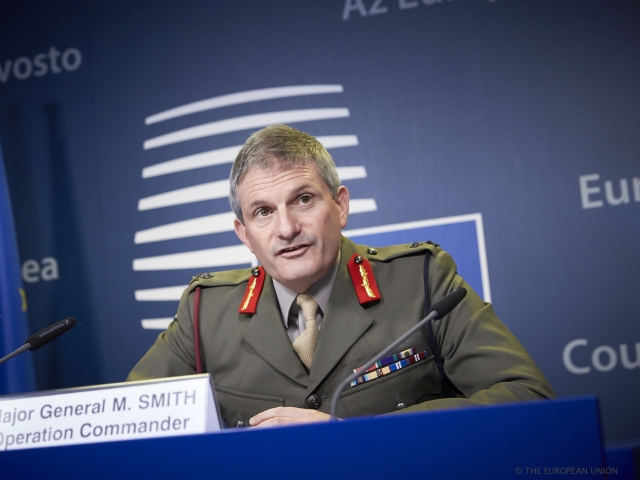
                                        Major General SMITH, Operation Commander of the EU Naval Force 2016Major General Martin SMITH, the Commander of European Union Naval Force in Operation Atalanta, during a press briefing in Brussels 2016 © European Union

Sir, it is real honor to have this interview with you. Thank you for accepting this invitation.

Q: The EU NAVFOR has achieved a resonating success, in its ongoing Operation. Yet the final outcomes requires a longer commitment of the EU Naval Force— that to imply the extension of its Mandate beyond 2016.

  • To what extend would you agree?

Major General Martin Smith: Over the coming months we will continue to work with WFP, Maritime Industry, counter-piracy partners, international organisations and regional states to assess the threat to shipping transiting off Somalia, and what type and level of security measures will be required post 2016 to ensure that piracy does not once again return to those waters. As you can see from a press release from the ‘Council of European Union’ Following a comprehensive review of this engagement, the Council confirms its intention to extend the mandates of the three CSDP  missions and operation until December 2018, with a view to further enhancing the EU’s Comprehensive Approach in Somalia and the Horn of Africa, in particular the security-development nexus. In this regard, the EU reiterates its resolve to implement as soon as possible its initiative for Capacity Building in support of Security and Development (CBSD).’

  • Please give us an overview of the Operational success up to present time.

Major General Martin Smith: At height of piracy in January 2011, 736 hostages & 32 ships were held from ransom.  As I speak to you today, there are still 26 hostages, but no ships are held.  If you look at factors such as intent, capability and opportunity, Operation Atalanta and the other counter-piracy task forces have, through close coordination, successfully deterred and disrupted pirates at sea and significantly reduced their opportunity to attack ships. 

The self-protection measures, Best Management Practice (BMP), employed by the Shipping Industry and their use of private armed security teams have also had a significant impact, as they have made it very difficult for the pirates to get on board and take a ship for ransom.

The legal process used by the EU to prosecute suspected pirates has also proven to be a notable deterrent, as pirates know that there could be a high price to pay if they go out to sea to attack ships. 

The EU operates a ‘detain and prosecute policy’.  We will always seek, where possible, a legal finish.  Legal handovers are made on the advice of the capturing nation’s Foreign Affairs Department and on the understanding that detainees would receive a fair trial and be treated appropriately. 

We assess pirates still have intent and capability, so International Community must remain vigilant.
Read more

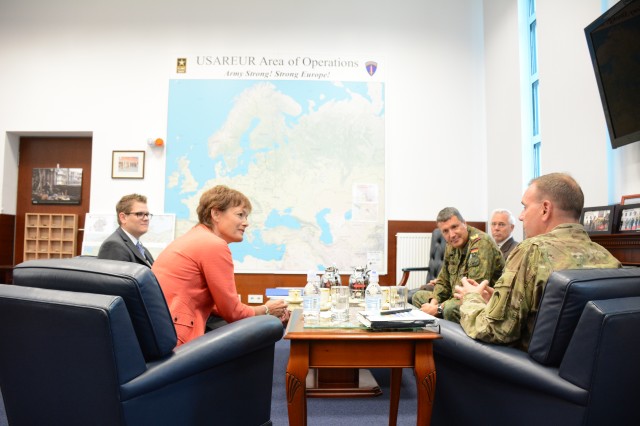
Interview with Minister Lucia Puttrich and her official visit to U.S Army European Command


Interview with H.E.  Minister Lucia Puttrich, Minister of European and Federal Affairs and Representative of the State of Hessen at the Federal Government of Germany, conducted by U.S Europe World Affairs Editor in Chief.


Your Excellency thank you very much indeed for accepting this interview. 

Q: You had an official visit at the end of August to U.S Army Center Europe. Please tell about us your general impression of the US Army in Germany, especially in regard with a great relations between die Bundeswehr and U.S Armed Forces.

H.E.  Minister Lucia Puttrich: My visit to the US-Army Europe headquarters in Wiesbaden was very interesting. We, as state government, have a close and trusting relationship to the US armed forces in Hessen. This is certainly due to a long history. We, as Germans, are very grateful to the USA that we were given the chance to rebuild our country according to democratic principles after the Second World War. For this, important decisions were made in Hessen. In 1948, the Hessian Constitution was signed at the Headquarter of the US armed forces and on July 1, 1948, the eleven West-German Minister-Presidents were given the mandate to prepare a German constitution.

The good cooperation, including in the civil-military area, is highly important for the safety of our citizens, especially in the face of present threats and challenges. Meeting Lt. Gen. Ben Hodges and his team convinced me of this [necessity]. Speaking about the good relationship between the Bundeswehr and the US Army here in Europe, it is of course remarkable that a Bundeswehr-General serves as chief of staff here in Wiesbaden. This is not self-understood but a strong sign for the importance of the German-American cooperation in this area.

 Q:  How the American presence in the South is received and welcomed by the local community.

H.E.  Minister Lucia Puttrich:  We, the people of Hessen, are open-minded and good hosts. We make sure that the soldiers, the civil employees and their families feel at ease here. Moving the European headquarters of the US army from Heidelberg to Wiesbaden is a sign for the good relations between the USA and Hessen. This was a groundbreaking decision of the US army with a highly symbolic character. The people of Wiesbaden and the people in the region have gained new neighbors with the relocation. We want to maintain the same close and good relationship we are presently enjoying. The people of Hessen have a strong welcoming culture.

 Q: What are the outcomes/benefit of this friendship between your government and great community in the south with the Americans.

H.E.  Minister Lucia Puttrich:  The German-American friendship also has a positive influence on the civil-military cooperation – not only with the US armed forces but also with the local command of the Bundeswehr. The trusting cooperation and the continuous exchange of information between the State Government, the ministry of the interior and the respective armed forces is remarkable.

News from:  U.S Army Europe and Africa         Hessen Government 

                                             follow us:          @USEUWAffairs   


Image:  U.S. Army Europe headquarters welcomed Minister Lucia Puttrich, the Hessian Minister for European and Federal Affairs, who met with Lt. Gen. Ben Hodges, Commander of Army Europe, and his staff.  August 24, 2015 Wiesbaden, Germany ©U.S Army 

References:  Strong Europe, German-US Military partnerships

Hessian Minister of European and Federal Affairs visits U.S. Army Europe


* The Interview is subject to Copyright Law.  All Rights reserved.

© Hessen government / US Europe World Affairs.com.  


« Older Entries Recent Entries »